Sunday, April 24, 2016

A Book Review: Changes by Jim Butcher (The Dresden Files #12)

Changes, the 12th installment in Jim Butcher's urban fantasy series, The Dresden Files, materialized on my bookshelf as it shaked the paranormal world of Harry Dresden, Chicago's one and only professional wizard.

How is this book? Simply putting it, Changes restored my interest in The Dresden Files. When I reached the final page in Changes, I was keen to finding out what will happen in the next book. And I have not experienced this type of keenness since Dead Beat.

That is right, Changes is one of the better books in The Dresden Files series. As its name suggests, Changes snapped out of the formulaic storytelling found in its predecessors, and refreshed this series with a major overhaul to the narratives. And the result is very positive.


Synopsis:

Harry Dresden has had a rewarding career as Chicago's only Supernatural P.I. In a decade, Harry helped the police and cracked down dozens of supernatural crimes, while waging countless battles against malicious, preternatural entities lurking in Chicago's shadowed alleys. From vampires, demons, fairy queens, werewolves to dangerous warlocks, Harry has fought them all to protect those he loved and he triumphed in every encounter. Harry risks his life on a daily basis, while he may not be earning big $$$ for his detective works, but he is doing what he loves and he is the best in the business.

Then along came Harry's ex-lover, Susan Rodriguez, who brought Harry's world crumbling down when she revealed a secret to Harry; that they have a daughter and she is being kidnapped by Harry's past enemy Arianna Ortega, Duchess of the Red Court vampires.

Suddenly, Harry found himself racing against the clock to free his daughter from the claws of the blood-thirsty Red Court...

My thoughts on this book:

Set in the metropolitan city of Chicago, pulsing with a strong neo-noir vibe, and fueled with explosive actions, The Dresden Files series captured the hearts of millions of readers with its vivid characters and compelling stories. It suffices to say, The Dresden Files established itself as a major player in the genre of urban fantasy. These novels, featuring the stoic, supernatural P.I. Harry Dresden, stormed my reading world some 16 months ago and I have been enjoying most of these books; they are fun reads.

Jim Butcher is a talented writer. His stylistic writings painted stunning visuals in the dark, magical world of Harry Dresden. Jim Butcher's prose breathed life into his memorable characters, Chicago, and its supernatural communities. These books are immersive. They are dark but colorful. Dreadful entities reside in the world of Harry Dresden, haunting Chicago's streets under the shadow of black nights. But Dresden's world is also a place of hope, where larger-than-life heroics, committed in the hands of courageous people, are serving as a radiant light to keeping the shadows at bay. This is a place I love visiting, a place I want to visit again and again.

Having praised the series, my biggest complaint about The Dresden Files is its episodic, repetitive nature. Jim Butcher has the tendency to recycle plot devices in his books. This means, not only are these books formulaic, but when it comes to establishing a sense of urgency and continuum these books leave much to be desired.

Then along came Changes, where Jim Butcher revised his storytelling and injected much welcomed refreshments into the tale of Harry Dresden. How? For the first time, Jim Butcher finishes a Dresden Files book on a cliffhanger. It is an ending that keeps its reader guessing, and it also hints at many interesting things to come. When I finished reading Changes, I could not wait to read the next book because the story reverberates a sense of urgency and mystery.

This also means, if you are a new adventurer in Harry Dresden's world and found the first 4 books repetitive, then exercise perseverance. This series is worth it. My personal opinion is, starting from book 7, The Dresden Files novels got better and better with the coming of every new installment. If your dream is to reading an urban fantasy series flavored in detective fictions, then don't hesitate, The Dresden Files is for you. On the other hand, if you are a veteran reader to The Dresden Files series, then you wouldn't want to miss out on Changes. This book is one heck of a roller coaster ride.

Until the next time, happy reading!


Saturday, April 9, 2016

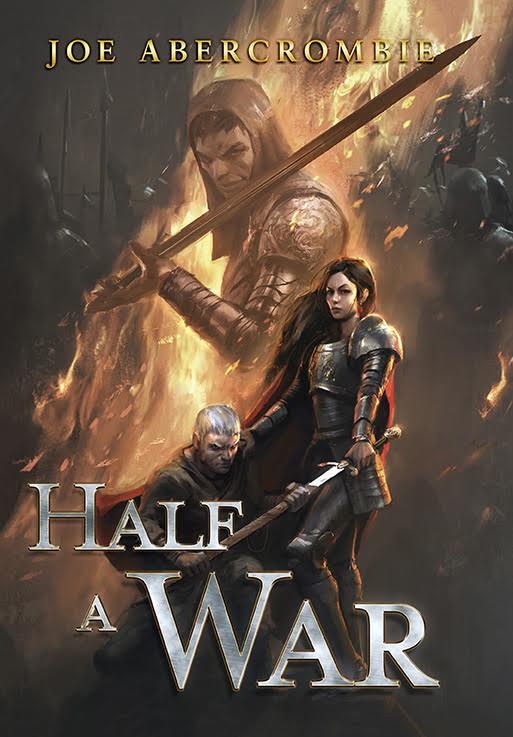
A Book Review: Half a War by Joe Abercrombie (Shattered Sea #3)

Most novelists take years to finish a fantasy trilogy. For Joe Abercrombie, the prince of grimdark fantasy, writing a trilogy is a matter of 12 months. In July 2014, Joe Abercrombie brought more gritty goodness to the table of the ever-flourishing fantasy genre when he published Half a King, the first installment in a new trilogy called Shattered Sea. One year later, Abercrombie finished his trilogy on high ground with Half a War, the third and the final installment in Shattered Sea. But before I continue and review Half a War let me ask you two questions:

  1. Do you like Jack Vance's Dying Earth?
  2. Do you like Frans G. Bengtsson's The Long Ships?

If your answer “yes” to both questions, then Joe Abercrombie's literacy creation, Shattered Sea trilogy, might be right up your alley.

Upon the first glance, the story in Shattered Sea appeared to being set in an epic fantasy world. However, as the story in Half a King led into its sequel, Half a World, Abercrombie gradually unveiled his was in fact, spinning a tale of blood and thunder in post-apocalyptic Scandinavia. A world where thousands of years after a great cataclysm, its civilization has regressed to an equivalent of medieval level. In other word's, reading Abercrombie's new grimdark trilogy is like reading post-apocalyptic novels packed with Viking actions!

I love both Half a King and Half a World. Recently I received a copy for Half a War, and ever since I finished reading it I have been bursting with an eagerness to review this book.

Synopsis:

Only half a war is fought with swords

So what do you fight the other half of the war with?

Princesses Skara is seeking, desperately, for the answer to this question. Why? The High King, guided by Mother Wexen, breached a peace agreement with her grandfather, King Fynn. The High King and Mother Wexen sent a colossal army, led by the infamous warleader Bright Yilling, to invade Skara's beloved country.

Skara fled as she watched Bright Yilling slaughtering her grandfather in the throne room. Meanwhile, the invading army butchered her people and torched the land that nourished her since birth. She swore vengeance against Bright Yilling and she made a promise to reclaim her birthright. But Skara is just a girl of 17, she hardly has the strength to draw a sword from its scabbard, and now she is a princess without a land and subjects. What can she do?

In her exile, Skara met a cast of extra-ordinary individuals; from the deeply cunning Father Yarvi, and fierce fighters such as Thorn and Raith, to legendary kings like Uthil and Gorm-gil-Grom. How will their lives tie in with Skara's plan for vengeance?

My thoughts on this book:

Half a War provides a deeply-satisfying conclusion to Shattered Sea trilogy. With fast-paced, energetic, and character-driven narratives Half a War send veteran readers of this trilogy back to the violent and bleak world of Shattered Sea. Joe Abercrombie's masterful prose and storytelling, famously debuted in his ground-breaking work, The First Law trilogy, returns to make readers fall in love with this book as its narratives spill seamlessly onto its white pages.

Every book in Shattered Sea trilogy features different POV(s). In Half a War, Abercrombie casts three new POVs to take the centre stage of the story; Skara, Raith and Koll.

Out of all characters in this book, I am most fond of Princess Skara. In this book, Skara is a 17 year old princess who was forced into an exile after her grandfather, King Fynn, was murdered in the hands of an invading army. The invading forces captured Skara's land and her subjects, so her shoulder is suddenly yoked with the responsibility of restoring her country. Yet, Skara possesses no martial ability of any sort. In the face of her insurmountable task, Skara had to conquer her fear and sharpen her wits to craft a plan and reclaim her birthright. Her story of survival and revenge is as a lone boat sailing in the raging sea. Skara's character and quality really grabbed me in this book. As the story progressed, her character transformed and grew visibly. Her character development is both steep as well as interesting. Skara reminds me a little of Daenerys Targaryen from A Song of Ice and Fire.

I also like Raith. Initially, he appeared in the story as a bloody-thirsty raider/warrior, a character who gave little thoughts about life and focusing his entire being on blood-letting and raiding works. As the story progressed, Raith witnessed the dark political games played by the rulers in Shattered Sea, and his perspective began to change. Like Skara, Raith's character underwent significant transformation too. His journey of transformation was fascinating, and he certainly left a deep impression on my mind long after I closed the last page in Half a War.

The third protagonist appearing in this book is Koll. He is apprenticed to Father Yarvi, who was the protagonist in Half a King. In Half a War, Koll is training under Father Yarvi to be ordained as a minister. He was constantly torn between whether to take the high path and changing the world as a minister, or taking the path leading to a carpenter's life and marry his love interest. Without spoiling the story, let me just say like Raith, Koll also witnessed the dark political games played by the kings and ministers, leading to his personal transformation and fascinating character development.

Aside the three newly introduced POVs. All of our favorite characters from previous books, such as Thorn, Father Yarvi, Brand, Uthil, and Gorm-gil-Grom, returned in Half a War and playing vital roles as support characters. Readers will find as the stories for these characters unfold, many twists and turns await for them in this atmospheric tale. I believe most readers will not be disappointed with the way Abercrombie wrapped up these characters' stories.

Half a War is an excellent novel. It tells a compelling story, and Abercrombie crafted characters both likable and fascinating. However, I do have a small criticism about this book. In my opinion, the story ended anti-climatically. How? This book is standing at 400 pages, and about 75% into the book, its story reached its climax. This happened at the 300 page mark. Despite having had reached its climax, the story continued for another 100 pages and it was dragging a little. Sure, these 100 pages narrated the aftermath for the main story, and it tied up several loose ends in the story. But I believe the concluding section in this book would have been benefited by a small reduction in page numbers.

Other than some (very) minor flaws, Half a War remains a powerful and fitting conclusion to Shattered Sea trilogy. Joe Abercrombie is at his best here. He weaves a gritty and dark tale of blood and revenge. I highly recommend this trilogy to my fellow lovers of the fantasy genre, and I believe you will find plenty of things to love about this trilogy. Especially if you like grimdark fantasy and enjoy Abercrombie's previous works.

P.S. I strongly recommend reading this trilogy in the order of its publications. That is, starting from Half a War, followed by Half a World, and finally leading to Half a War. This is because the characters, events and stories in this trilogy are narrated in the chronological order.


Tuesday, March 15, 2016

A Book Review: Still Life with Crows by Douglas Preston and Lincoln Child

Who is the greatest fictional detective in literature? Sherlock Holmes? Robert Langdon? Hercule Poirot? Auguste Dupin? 

After I finished Still Life with Crows, I believe Aloysius XL Pendergast, who is a special agent of the FBI, should join the rank as a formidable detective in literature.

Let me put it this way: Imagine, a serial killer is running loose in your neighborhood. Who you gonna call? I tell you, Agent Pendergast is the man for the job.

Who is Agent Pendergast? He is a fictional character, created by Douglas Preston and Lincoln Child, who are two novelists writing in collaboration. Pendergast made a debut in Relic, a techno-thriller novel published in 1995. Since then, Agent Pendergast's adventures have spanned over 15 books up to date. Still Life with Crows is standing as the fourth installment in this thrilling series of novels. Reading Still Life with Crows makes your heart pound against your chest, as if you are hanging on for your dear life on a roller coaster ride.

Synopsis:

In America's heartland rests a small Kansas town called Medicine Creek. Nothing changes in this town; its surrounding cornfields seem boundless, and along the town's main street squats a two-block stretch of dusty and old businesses.

Although Medicine Creek is dwindling, but its residents are leading a peaceful life. Amidst a summer's blazing heat, Medicine Creek's serenity shattered, abruptly, when a series of ghastly murders and mutilated bodies were discovered in the town's seminal cornfields.

These harrowing murders drew Agent Pendergast's attention to Medicine Creek. He arrived at the town, aiming at catching the killer like a hunting wolf sniffing for its prey. But soon Pendergast discovered the one behind these murders is no ordinary serial killer. This time, Pendergast stares into the eyes of evil, an evil lurking under the shadows from Medicine Creek's haunted past.

My thoughts on this book:

Macabre, is my choice of word for describing Still Life with Crows. In this fast-paced thriller novel, Douglas Preston and Lincoln Child spun a riveting yarn. Its story morbidly fascinates a reader with bizarre murders, and it will send a chill down your spine. Taut with nerve-wracking suspense, this book's convoluted plot turns and twists as its storytelling blasts a reader in the face with unexpected surprises. This book kept me turning the pages from its beginning until its very end, and I loved every page it.

Characters, Still Life with Crows boasts a cast of vividly colored characters. Agent Pendergast, charismatic and intelligent, rocks the story's centre stage with a performance worthy of Sherlock Holmes. This man's deductive power is simply off the chart! Yet, the adventure in Still Life with Crows does not light its stage with a one man show. Supporting characters, notably a Goth teenage girl named Corrie Swanson, shined brightly along side Pendergast's staging. The author(s) blended Corrie's side story smoothly into the main plot like a pair of matching gears.

Without a terrifying, dangerous villain a thriller novel cannot come to life. This book takes its readers on a perilous journey, a journey staring into the face of an utterly terrifying villain. I will not spoil the story in this review, but I think it suffices to say the villain in this book is an individual so strange, so menacing, yet so fascinating that most fictional villains pale by comparison.

A good thriller novel can make a reader's heart pound frantically even if you are resting in the comfort of a couch. Still Life with Crows kept me at the edge of my seat. The cornfields! In this book, scenes of abominable horror transpired in the cornfields, and those scenes are among the most frightful events I have ever encountered in a novel. When I was turning the pages in this book, its atmospheric settings engulfed me in torrents of suspense, horror and mystery. I could not put this book down! I burned with the need to know the story's end and I finished this 560 page book in 2 sittings. A word of advice, I recommend reading this book during a weekend instead of on a night after work, lest you stay up the whole night racing through the book and then struggling at work the next day because you are sapped of energy.

My review for Still Life with Crows comes with high praises. But you might ask:

“Is there any negative aspect about this book?”

I answer this question with a big “NO”. In all honesty, I could not recognize any item to be criticized in this book. I loved Still Life With Crows from the first page until the very last one. I had a blast of a time reading it. This book, and its predecessor (The Cabinet of Curiosities, check it out if you haven't read it yet) nestled themselves at the very top of my list for favorite thrillers novels. I highly recommend Still Life with Crows to lovers of the thriller genre, especially if detective and horror stories appeal to you.

P.S. I will be away on a holiday in the upcoming 2 weeks. During this time, I will not be able to read books or writing reviews. But fear not, my gentle readers, Daniel's Corner Unlimited shall return in the month of April. So until the next time, happy reading!


Saturday, March 5, 2016

A Book Review: The Republic of Thieves by Scott Lynch (The Gentlemen Bastards Sequence #3)

“Now I have to wait for the next book.”

The problem of being captivated by an unfinished series of fantasy novels, is that you have to wait for the next book. In the fantasy genre, authors usually plan on writing long series, lengths varying from 7 to 10 books, and the wait for the next book often stretches to several years.

It is almost like dining on a beautiful, 7 course meal but knowing the dishes will only arrive at your table, sequentially, once in every few hours. That, is how I felt when I turned to the last page in The Republic of Thieves, the 3rd entry in Scott Lynch's highly acclaimed fantasy series, The Gentlemen Bastards Sequence.

Starting with The Lies of Locke Lamora, I stepped into the adventures of The Gentlemen Bastards three weeks ago. Every page of story in The Lies of Locke Lamora charmed me, and the novel joined my list of favorite books. When the time came for reading its sequel, Red Seas Under Red Skies, the book did not disappoint despite having some pacing issues. Next up, I eagerly opened The Republic of Thieves. This book is the 3rd installment in the series, and I enjoyed this novel so much that I dreaded the inevitability of reaching its final page, knowing that agonizing months await me before the next book can finally greet my reading world.

However, before I return to waiting for the next book, I would like to share my thoughts on The Republic of Thieves. Hopefully my review will convince you to start reading this series too, so you can join me in the agonizing wait for the next book and sharing my pain. Just kidding!

Let me begin with a synopsis for the novel.

Synopsis:

Locke lies on a sickbed, slowly dying while a lethal poison tears through his body.

Unfortunately, no physiker or alchemist possess the skills to purge the poison from Locke's frame. His dearest friend and fellow Gentlmen Bastards, Jean Tannen, looks on at Locke, in grief and in anger at the poisonous sickness stalking his friend's life.

At the moment when the poison was about to extinguish the last breath of life in Locke, an enemy from their past, a Bondsmage, materialized in front of Locke's bed, offering a bargain in exchange for ridding the venom from his body.

What is the catch? This Bondsmage promised to expel the poison from Locke's body, provided that Locke and Jean agree to take on an assignment in the city of Karthain. This assignment, should Locke and Jean agree to contract it, requires them to act as experts to help winning an election for a political faction supported by Bondsmage. The difficulty is, there are two political factions in Karthain, and their opponent's political campaign is led by Sabetha Belacoros, a woman who not only dominates Locke's love life, but she is also an ex-member of Gentlemen Bastards with wits and cunning rivaling Locke's own.

Locke and Jean have no option but to take on the assignment in exchange for the cure. So begins a spectacular match consisting of intrigues and stratagem, intertwined with old romances and personal history, a history tracing its root to a theatrical known as The Republic of Thieves.

My thoughts on this book:

I find Scott Lynch's writings admirable because he is not afraid to try new things. He began The Gentlemen Bastards Sequence with a revenge story, then he expanded the series with a sequel about pirates sailing on a nautical adventure. Lynch continues to reinvigorate this series in the 3rd installment by telling a story about romances and political heists. That is right, The Republic of Thieves is both a political heist story as well as a tale of romance, where readers finally meet Locke's love interest, Sabetha Belacoros, who was mentioned multiple times in the previous two novels but never made an actual appearance until now.

Sebatha made an impressive entrance onto the stage of The Gentlemen Bastards Sequence. She entered the story as an antagonist to Locke and Jean's operation in this book. Audacious and clever, Sabetha mirrors Locke both in personality as well as abilities and skills. She proves herself a worthy opponent, trading blows of intrigues and stratagem against Locke and Jean. Their rivalry creates an electrifying story about a political heist, where most actions do not reside in physical combats, but instead the actions take places in the form of Locke and Sabetha outsmarting each other to win the election for the political faction they each represent. Furthermore, the story of Locke and Sabetha's rivalry is abundant with humorous touches. When I was reading this book, there were many occasions when lighthearted humors brought smiles on my face. In my opinion, the theme of political heist aligned with The Genlemen Bastards Sequence perfectly, especially because this is a fantasy series of a grimdark persuasion.

Aside from the political heist story, this book also explores Locke and Sabetha's romantic relationship, one that takes place in the present as well as how their romance originated in the past. These two, parallel stories not only gave depth to Locke's character, but they also provided readers with insight into the background of the overall story. In other words, The Republic of Thieves contains two narratives. It is a book flashing between the past and the present. One narration takes place in the present election in Karthaine. The second narration unveils the curtain of history behind Locke and Sabetha's romantic relationship.

One might expect this type of storytelling, flashing between the present and the past, may confuse readers with time jumps. However, Lynch's storytelling works exceedingly well here. Starting from the first book in this series, Scott Lynch has been employing this storytelling device to all novels in The Gentlemen Bastards Sequence, where each chapter consists of two parts: The first part focuses on the events at the present, and the second part details a story that took place in the past. This narrating format gave Lynch an edge as a storyteller to jump straight into the story, painting vivid, detailed portraits for his world and characters, yet smartly evading a slow buildup at the beginning of his book(s). It is also worth mentioning that surprisingly, Lynch's unusual storytelling format provided smooth transitions in between chapters without ever raising a sense of disruption.

The Republic of Thieves is an excellent novel. However, I still opine the first book in this series, The Lies of Locke Lamora, is the best novel in The Gentlemen Bastards Sequence (so far). Having said this, I prefer The Republic of Thieves to its predecessor, Red Seas Under Red Skies. In The Republic of Thieves, I found the political heist story intriguing, it matches the overall theme of this series like a swimming fish in the water. On the other hand, the tale of romance between Locke and Sabetha fleshed out the key characters in this series, giving them depths. I had a great time reading this book and I cannot wait to read the next book. As I said earlier, now begins the agonizing wait for the 4th book in this series. The next installment is titled “ The Thorn of Emberlain”.

P.S. I have attached a link to a book trailer for The Republic of Thieves, it is made by the publisher Gollancz.


Saturday, February 27, 2016

A Book Review: Red Seas Under Red Skies by Scott Lynch (The Gentlemen Bastards Sequence #2)

So you have read a fantasy novel about mighty warriors, kings, queens, dragons and big wars. But have you read a fantasy novel about thieves and heists? If not, then I recommend to you a wonderful book titled The Lies of Locke Lamora. It is the first book to a series of novels written by Scott Lynch, a series known as The Gentlemen Bastards Sequence.

I read The Lies of Locke Lamora last week and I enjoyed every page of it. This week I read its sequel, titled: Red Seas Under Red Skies. As the book's title suggests, this story has something to do with the sea. In fact, Red Seas Under Red Skies differs considerably from its predecessor. Instead of rehashing the elements that gave success to The Lies of Locke Lamora, in this sequel, Scott Lynch explores a new avenue for his story. I admire Lynch's audacity for trying to write something new in a sequel. Firstly, let me provide a synopsis before I begin to share my thoughts about Red Seas Under Red Skies.

Synopsis:

In the exotic city of Tal Verrar sits the towering Sinspire, a luxurious gambling house buzzing with high class entertainments. In a decadent venue such as Sinspire you can find people burdened with wealth. Their burdens, however, are about to be relieved by Locke Lamora and Jean Tennan, con man extraordinaire, who stepped into Sinspire with an elaborate plan to reach their hands into its teeming vault of treasury.

Locke and Jean's plan came very close to fruition, but the duo's secret was discovered and subsequently came into the hands of a high power in Tal Verrar, who blackmailed Locke and Jean into taking a dangerous job. Before long, the Gentlemen Bastards find themselves on board a pirate ship, sailing on red seas under red skies.

My thoughts about this book:

Set in the crowding city of Camoor, The Lies of Locke Lamora began The Gentlemen Bastards Sequence with a revenge story. In the series' second installment, Red Seas Under Red Skies, Scott Lynch takes his readers away from the urban setting, embarking on a sprawling pirate adventure scouting the exotic towns and ocean ports among Sea of Brass.

That is right! Red Seas Under Red Skies is a fantasy pirate adventure. While this book still centres itself around a series of heists, featuring our beloved Locke and Jean pulling off games after games of cons, but the theme of a pirate adventure, one that rarely appears in fantasy novels, is utilized in this book to craft a unique and ripping yarn. In this book, Locke and Jean's journey on Sea of Brass gave readers a taste for the vastness of this fictional world.

In other words, Red Seas Under Red Skies sets its ambition high. Not only does it continue the excellent story that began in The Lies of Locke Lamora, but this sequel also attempts to expand the universe of which these characters dwell, in the process setting up the premises for future installments to this series.

Did this book succeed at what it attempted to do? How does its quality measure up against its predecessor?

I admire Red Seas under Red Skies for its scope and ambition. In this book, Scott Lynch tells an engaging story that is both excellent in its writing as well as its characterizations. The setting in Red Seas under Red Skies reminds me of Pirates of the Caribbeans movies. The worldbuilding in this book is detailed but not cumbersome. Locke and Jean's adventures on a pirate ship came vividly to life under Lynch's beautiful writings, while portrayals for sea towns and ports were depicted with vibrant descriptions that immerse its readers deeply into the exciting world of The Gentlemen Bastards.

Red Seas Under Red Skies excelled at its writings, characterizations, and worldbuilding. Despite these qualities, this book is not flawless. Personally, I prefer The Lies of Locke Lamora than this book. An uneven pacing of the story prevents this sequel from being as great as its predecessor. Red Seas Under Red Skies started off with exciting narratives in the first 150 pages. This book's first act let its readers re-live the excitements that flow in the veins of its predecessor. However, when the book reached its second act, the story's pace slumped, and the chapters moved slowly for the next 200 odd pages. When I was reading this book, boredom was setting in as the story reached its halfway mark. Fortunately, the story picked up its pace after the halfway mark, rapidly gaining momentum in the last 250 pages until the book concluded in a spectacular manner. In my opinion, the plummeting pace in the middle of the story stands as the greatest flaw in Red Seas under Red Skies, while an excellent start and a stunning conclusion pushed this book above the standard as one of the better novels in the fantasy genre.

The Gentlemen Bastards Sequence is an excellent series. Scott Lynch's fictional world, one that resembles the late renaissance, is a beautiful and lively place, inhibited by memorable characters who will live on in your mind even after you close the books. This series began with a stunning debut novel called The Lies of Locke Lamora, and the story continued in its sequel, Red Sea Under Red Skies. While this sequel may not be as great as its predecessor due its uneven pace, but it is nevertheless, still a fine tale with an intriguing start and a spectacular conclusion. I highly recommend this series to fans of the grimdark fantasy genre, especially to those who are fond of novels written by authors such as Robin Hobb and Patrick Rothfuss.

P.S. I wish to compliment the cover for this book. It is as gorgeous as the cover for The Lies of Locke Lamora. 


Saturday, February 20, 2016

A Book Review: The Lies of Locke Lamora by Scott Lynch (The Gentlemen Bastards Sequence #1)

Take a look at the image sitting at left hand side of the screen. The image is the cover art for a book called The Lies of Locke Lamora. Don't you think it looks gorgeous?

The conventional wisdom says: Do not judge a book by its cover.

That is true. But some books tell stunning stories, stories that deserve to be covered in gorgeous artworks. This is the certainly the case for an enchanting story known as The Lies of Locke Lamora, and only a handsome book cover can do this novel justice.

I think it suffices to say, this novel is sitting high up on my ever-growing list of favorite books. But what is The Lies of Locke Lamora? Let me provide a short description: Try to imagine Catch Me if you Can (the movie) + grimdark fantasy, set in a fictional world resembling the late renaissance.

Does this interest you? If so, feel free to continue reading my non-spoiler review.

Synopsis:

Built on the ruins of a forgotten race, Camorr is an island city teeming with a rife populace and grand architectures. On the surface, the city is exuberant with trades. The street corners and its shadowed recesses, however, belong to the underworld crime bosses.

In Camorr, an orphan is usually destined to live a short and harsh life. Locke Lamora is an orphan, who, with his quick wit and talents for thieving, made a narrow escape from death and slavery at an young age to be apprenticed under Father Chains, a master thief.

Father Chains passed down the arts of thievery to a selected group of orphans, collectively known as The Gentlemen Bastards. Under his tutelage, Locke grew up and became a con man extraordinaire, leading The Gentlemen Bastards and pulling off case after case of ingenious cons. In Camorr, not a treasure vault, and not a wealthy noble, is immune from Locke's bite.

Under Locke's brilliant leadership, he knitted The Gentlemen Bastards into a close family, the wealth they “acquired” from unsuspecting nobles grew into a king's ransom. Meanwhile, to the eyes of Camorr's most dangerous crime boss, Locke and his brothers successfully passed themselves off as nothing more than petty thieves. The Gentlemen Bastards were having a great time, until an ambitious and dangerous individual, hiding in the shadows and cloaked all in gray, began pulling strings of devious plan, shaking Camorr' foundation.

My thoughts on this book:

We have seen the fantasy genre tell stories of great battles, national conflicts, political intrigues, dragons, wizards, and mighty heroes. But there aren't many fantasy stories about heists. In this regard, The Lies of Locke Lamora, the debut work for author Scott Lynch, stands out as a unique gem because it is a story about a heist and revenge. This story, flavored with occasional humor, also possesses a clever plot, and it is layered upon excellent worldbuilding and vivid characterization.

When it comes to the worldbuilding, Scott Lynch colored his fictional world, one that resembles the renaissance Venice, with rich and picturesque details. I like this fictional world, it is vast in scope and fascinating with its liveliness; from the buzzing city streets in Camorr, its renaissance inspired architectures, its fascinating culture, to the cloak-and-dagger atmosphere surrounding the city's criminal underworld, the world of Locke Lamora came springing to life under Scott Lynch's superb worldbuilding. This is a fictional world that will deeply capture a reader's imagination, worthy of multiple revisits.

The Lies of Locke Lamora features a multitude of characters. Locke and his best friend, Jean Tennan, play the roles of protagonists. Both Locke and Jean are likable and memorable characters, and Scott Lynch portrayed both of them with masterful skills.

Locke, cunning but fiercely loyal, possesses little martial prowess. This characteristic made Locke stand out from the galore of fantasy heroes who are usually great warriors. In a physical combat, Locke cannot fight to save his own life. However, Locke's virtue lies in his formidable power as a con man and a mummer. In sum, this book probably has more than 50 pages worth of sequences where Locke tried to con his way out of perilous situations and dangerous ordeals. Those breathtaking sequences, cleverly conceived and brilliantly written, are among of the most entertaining “action” scenes I have ever encountered in a book. I lost count of the times when I breathed sighs of relief when Locke successfully conned his way out of dangers.

On the other hand, Jean Tennan, Locke's fellow Gentlemen Bastards, is depicted as a loyal friend whose personality and skill sets complement Locke's own. Jean, who is more serene than Locke, is a skilled thief as well as a formidable fighter. He is the “tank” in their finely established organization. Jean has a heart-warming friendship with Locke, and he plays a pivotal role in this book.

Aside from Locke and Jean, the story also features support characters. All support characters are memorable and noteworthy. However, the support characters who stood out the most, are the other members in the Gentleman Bastards, namely the twin, Calo Sanza and Galdo Sanza, as well as a 12 year old boy called Bug. When I was reading this book, I found myself growing very fond of these characters as the pages moved. The antagonist in this book, whose identity I will not reveal in this review, is portrayed brilliantly as a cunning and dangerous individual. Let me just say, as the Gentlemen Bastards clashed course against their antagonist, it produced a intriguing tale bursting with surprises and twists that will keep you at the edge of your seat, furiously turning the pages until the story reaches the final page.

I wish to make a note about the style of narration found in this book. Scott Lynch employed an interesting method of storytelling. That is, every single chapter consists of two major parts. One part follows the plot that is taking place at the present time, where the second part describes the “flashbacks”, taking readers to the past and revealing how Locke and his fellow Gentlemen Bastards grew up. One might expect, such a storytelling method may cause confusions, or losing the sense for urgency in the transitions between chapters. But in The Lies of Locke Lamora, this method of storytelling worked exceedingly well. By telling a story this way, Scott Lynch not only mounted suspense and urgency for the main story, but he also provided background information without having to use a slow build up at the beginning of the book. In other words, Scott Lynch's story is fast-paced, but it is also rich with details. I admire the storytelling in this book, I think Scott Lynch told this story in a very clever and effective way.

The Lies of Locke Lamora received overwhelmingly positive reviews. Many readers and critics consider this book as one of the finest fantasy novels of the 21th century. I heartily agree with all these positive assessments. This book marks the beginning of The Gentlemen Bastards Sequence, a series running at the length of 7 books. Having said this, The Lies of Locke Lamora can be read as a stand-alone novel because there is no loose plot left untied at its ending. The sequels, as I understood, embark readers on completely new episodes in Locke and Jean's adventures. This means, if you try this book and do not find it to your liking, then you won't feel obliged to reading the sequel. However, if you read this book, and like me, you become spellbound by the charms of this series, then you would have discovered a treasure grove. In other words, this is a win-win situation with little to loose. So if you haven't read The Lies of Locke Lamora, then what are you waiting for? It is time to dive in and experience the magic of Scott Lynch's brilliant novel. I especially recommend this book to fans of Robbin Hobbs and Patrick Rothfuss.

Until the next time, happy reading! I am off to read the sequel, titled Red Seas under Red Skies.

P.S. I have attached a link (below) to a stunning fan-made trailer for this book. I believe this trailer captured the vibe for The Lies of Locke Lamora accurately and beautifully. Enjoy!


Saturday, February 13, 2016

A Book Review: The Bands of Mourning by Brandon Sanderson (Mistborn #6)

In The Bands of Mourning, best-selling author Brandon Sanderson returns to the world of Mistborn with my favorite book in the series so far. Succeeding Shadows of Shelf, The Bands of Mourning is the second book in a trilogy featuring the adventures of Wax and Wayne, whose charms would surely spellbound Mistborn veterans as well as newcomers to this series.

Synopsis:

Long ago, Lord Ruler forged the Bands of Mourning, a legendary artifact that could grant its wearer spectacular powers.

As centuries passed, the Bands of Mourning was forgotten, its existence fading into fables and legends. Until the day when a kandra researcher brought to the great city of Elendel strange images. These images, showing depictions of an unknown language, appeared to speak of the mythical Bands itself.

As these images saw the light of day, Kandra council recruited Wax and Wayne on the mission to rediscover the Bands. The mission took them to the southern city of New Seran, where Wax would uncover a conspiracy plotted by his uncle Edwarn and a mysterious organization called The Set.

My thoughts about this book:

After reading my synopsis you must be thinking, so the story revolves around a group of heroes traveling from one city to another, racing against an evil nemesis on a quest to discover a powerful artifact. The Bands of Mourning sounds like a typical fantasy story, right?

Not quite.

While the premise for The Bands of Mourning may appear cliched on the surface, but there are several reasons why this book departs from the fantasy conventions. In my no-spoiler review, I shall endeavor to explain why The Bands of Mourning is among the most interesting fantasy novels in existence.

First of all, The Bands of Mourning is a genre-blending novel. In the space of 400 pages, this fast-paced book brings together the best of two genres, fantasy and detective fiction, into its storytelling. In other words, imagine this novel as Sherlock Holmes with superhuman powers. At the centre of the story lies a mystery, it drives the plot forward and along the way, our heroes encounter crimes of murder and robbery. Solving these crimes gradually brought the heroes to the truth.

This books' intrigues do not end at its good story. The worldbuilding in this book deserves mentioning. Up to date, Sanderson has written 6 Misborn novels. The original Mistborn trilogy took place 300 years before the story of Wax and Wayne. This means, The Bands of Mourning, as well as its predecessor Shadows of Self, belong to the 2nd trilogy (Wax and Wayne trilogy) in the Mistborn universe. In Wax and Wayne trilogy, Sanderson did something revolutionary, something that is rarely seen in fantasy literature; he incorporated technological advancements into his fictional world. The world of Wax and Wayne resembles the late 19th century, it is a world where magic and technology co-exist, a place and time when people have just discovered electricity, invented light bulbs, motor cars, firearms, and telegram. Meanwhile, magic also exists in the fabric of ordinary people's lives. To finish it off, Sanderson put a master stroke to his fictional world with a touch of spaghetti Western.

So there you have it, The Bands of Mourning (and its predecessor Shadows of Self) is a detective fiction story set in a fantasy world, a place resembling the late 19th century Industrial revolution, where budding technology meets deeply rooted magic, and the story is decked out in a distinctive tone of spaghetti Western. Seriously, if you are a fan of fantasy fictions, how can you say no to this intriguing series?

The Bands of Mourning stands as the second book in Wax and Wayne trilogy. Sadly, we will have to wait for 2018 to read the concluding novel for this trilogy. Have no fear, however, for The Bands of Mourning does not end in a cliffhanger. This book has enough materials and a satisfying end, it can almost be treated as a stand-alone novel.

As the second book in the trilogy, I like The Bands of Mourning better than its predecessor, Shadows of Self. In this book, from the characters' dialogues to back stories, Sanderson explored the characters in great details. In comparison to Shadows of Self, Sanderson flashed out his characters with deeper developments in this book. This does mean The Bands of Mourning moves at a slower pace than its predecessor, but the slightly slower pace does not bother me at all, because I like the character development in this book. Shadows of Self introduced to me new characters such as Wax, Wayne, Steris, Melaan and Marasi. But I didn't really get to know them. In The Bands of Mourning, Sanderson's developed these characters in great depth, adding qualities and vividness to their portrayals. When I was reading this book, I felt as if I knew these characters. I grew fond of them and cared for them. When this book ended, I wanted to find out what fates await for them in the next installment. I think this is a sign of a successful novel.

Until now, I was never a huge fan of Mistborn series. I mean, I liked the original Mistborn trilogy, but I didn't love it. The 2nd Mistborn trilogy kicked off with Shadows of Self, while it deepened my fondness for the Mistborn universe with its unique worldbuilding and a genre-blending story, but I still didn't love the series. Then The Bands of Mourning came along and kindled my love for this series. What can I say? The Bands of Mourning is a really good book. If you are interested in reading Mistborn series, I recommend starting from the original trilogy, with a book titled The Final Empire.

Until the next time, happy reading!