Saturday, November 21, 2015

A Book Review: The Exorcist by William Blatty - 40th Anniversary edition

Then they sailed to the country of the Gerasenes, which is opposite Galilee. When Jesus had stepped out on land, there met him a man from the city who had demons. For a long time he had worn no clothes, and he had not lived in a house but among the tombs. When he saw Jesus, he cried out and fell down before him and said with a loud voice, “What have you to do with me, Jesus, Son of the Most High God? I beg you, do not torment me.” For he had commanded the unclean spirit to come out of the man. (For many a time it had seized him. He was kept under guard and bound with chains and shackles, but he would break the bonds and be driven by the demon into the desert.)

                                                                    - Luke 8:26-29

William Blatty opened his supernatural thriller, The Exoricst, with the above quote from the 8th Chapter in the Gospel of Luke. The Exorcism of the Grasene Demoniac is one of the most memorable stories in the Bible. However, this is not the only occasion when Jesus of Nazareth performed an exorcism. In fact, the Gospels accounted in Jesus' life time, he performed at least, 9 individual exorcisms. While theological implications exist behind these stories, but given the fact that Jesus and his disciples clearly believed the reality of demonic possession, one would have expected that 2000 years later, the followers of Jesus should also believe it, right?

Ok, imagine this scenario. A strange, unexplainable mental illness struck a 12 years old girl. The girl's mother, who is an atheist, consulted numerous medical professionals to no avail. All signs point to a demonic-possession. This is a paranormal phenomenon believed by many ancient cultures, recorded in holy books around the world, but ridiculed in the modern day as superstitions. Out of desperation, the girl's mother approached a priest for help, pleading for an exorcism, but the priest palmed her off (back) to the doctor. Why? As it turned out, the priest, who is supposed to believe this stuff doesn't believe it himself!

For the priest, faith has become a matter of philosophical, academic pursuit only. For the priest, the demonic possessions only happened in the holy book, it probably doesn't happen today. But even then, the priest argues, the demonic possessions in the holy book should be interpreted with sophisticated hermeneutics, to downplay the supernatural reality while emphasizing the philosophical, and theological meanings behind the miracles. This approach will somehow, bring his religious worldview up to scratch with a world that seeks rational explanations for everything. Meanwhile, perhaps the truth is, the priest doesn't really have faith anymore? In this case, when the faithfuls don't even have faith themselves, who can help this demon-possessed girl? (As a side note, I thought this premise sounds very familiar to a story narrated in the 17th chapter in the book of Matthew) 

With this premise (described above), William Blatty wrote a most captivating tale about faith. Indeed, after I finished reading this brilliantly written, fast-paced novel. I realized this novel is not just some horror story trying to entertain its readers with spooks. Instead, The Exorcist is a allegory about the internal struggles for modern-day religious believers, who, wrestle to adapt their own perception about faith to a world where everything is being rationalized.

I thought The Exorcist is an intriguing novel. This novel, counting to 400 pages, directs its theme and messages more at those with a religious persuasion than those who are without it. This novel has 4 major characters; 1) Regan McNeil, a 12 years old girl who was possessed by a demon, 2) Chris McNeil, who is Regan't mother, an established movie actress and an atheist, 3) Father Damien Karras, a priest with a wayward religious faith, whose background is psychiatry, and 4) Father Merrin, the exorcist and a renowned archaeologist.

The protagonist in this book, however, is Father Damien Karras. In the story, Damien was asked by Chris to help her daughter, Regan. Damien was highly skeptical about this alleged demonic possession. He examined Regan, and despite seeing many strange signs and paranormal evidence with his own eyes, Damien still rejected Regan's condition was an authentic case of demonic possession. Instead, Damien, with his background in psychiatry, insisted seeking naturalistic explanations for Regan's condition. Damien's reluctance to accept the fact Regan was possessed by a demon, is a manifestation of his own struggling faith in a modern world. On the surface, Damien wore the iconic, priestly collars, he symbolizes a faithful believer. However, when a supernatural event, one that was documented in his holy book, materialized in front of his eyes, then strangely he was unable to believe it is true. At this point, the story creates an ironic, fascinating scenario where a non-believer such as Chris was ready to believe based on the paranormal signs, but a believer such as Father Damien rejected these signs because he tried so very hard to rationalize his faith.

For an irreligious reader, this book may be a very interesting reading experience, where one may look at the story of Damien and become frustrated at him for being a believer yet denying the obvious evidence in front of him. Furthermore, The Exorcist story also raised an interesting question for the modern-day religious believers, who, based on their holy book, subscribe to the belief of a supernatural reality - when something unexplainable happens today, why do they often default to a naturalistic explanation over a supernatural one like the non-believers do?

Out of the 4 major characters in this book, Father Merrin stood out as a striking character. After Damien requested the church to grant an exorcism, Merrin was chosen by the church to perform the rite. During this episode, Merrin acted and spoke out of certitude and faith (not to be confused with certainty) that Damien found admirable. Damien reflected, that Merrin had a trusting faith that Damien did not have in himself. For Merrin, Regan's demonic possession was as real as the gravity pulling an apple down to the ground, but for Damien, Regan's demonic possession was his chance for testing if his god was real. Damien, was the doubting Thomas that most people can easily relate to.

At this point, one may ask, why read this novel if you have already seen the movie? My answer is this; if you have seen the movie and liked it, or if my review has roused your interest in this book, then reading this novel is going to worth every minute of your time, for two reasons: A) This novel explained the origin of the demon, which was omitted in the film, B) The novel, as a written medium, described and captured, vividly, characters' thoughts and emotions. This vital information was not communicated effectively in the motion picture adaptation.

I found The Exorcist to be an excellent book. This book is well-written, and it tells a fast-paced, engrossing story. This book is often dubbed "The scariest book ever written", but I did not find this book scary, it did not scare me at all. Instead, I was most intrigued by this book's theme and its underlying message. This novel's ending generated some controversy, if you have seen the movie then you probably have an idea what is this controversy. However, I think that controversy belongs to a different discussion, and it is unrelated to the central theme of this book. Meanwhile, at its core, The Exorcist explores the thought-provoking topic about the perception for the nature of faith in the modern world, and it does so brilliantly by telling a spectacular and entertaining story.

P.S. This review is based on 40th anniversary edition for The Exorcist. Apparently, in this edition, the author restored some contents that were previous omitted in the original edition.


Tuesday, November 10, 2015

A Book Review: The Cabinet of Curiosities by Douglas Preston and Lincoln Child

Cabinets of curiosities – Also known as “wonder rooms”, were small collections of extra-orindary objects which, like today's museum, attempted to categorize and tell stories about the wonders and oddities of the natural world.

Douglas Preston and Lincolon Child, these 2 authors' names should ring bells for lovers of crime thrillers and detective fictions. In 1995, this duo published their first collaborative work, Relic, an atmospheric, techno-thriller novel set in New York Museum of Natural History. Relic became an instant success and an international best-seller. Furthermore, Relic began a saga for one of the most memorable fictional detectives in the 21th century, Aloysius X.L. Pendergast, a formidable FBI special agent.

Up to date, Douglas Preston and Lincoln Child have written 15 thriller novels featuring the adventures of agent Pendergast. Readers around the world received all 15 novels positively. However, a quick search on Goodreads reveals that The Cabinet of Curiosities, the 3rd book in the series, has the best rating out of all Agent Pendergast novels. In fact, The Cabinet of Curiosities currently scores a stunning 4.25 out of 5 stars on Goodreads, which is an unusually high score for a thriller novel.

At this point, I am going to jump ahead, and say The Cabinet of Curiosities deserves these high praises and the good reviews. In my time as a reader, I have yet to feast my imaginations upon a thriller novel that is more gripping, and more thrilling, than The Cabinet of Curiosities. Today, on Daniel's Corner Unlimited, I would like to provide a review for this mesmerizing novel.

Synopsis:

A construction site in downtown Manhattan unearthed a blood chilling discovery. Buried underneath New York's buzzing metropolis lay a charnel house. It stored 36 mutilated corpses belonging to victims who were murdered in the 19th century. This is the biggest serial murder in US history, its grotesqueness is rivaled only by the horrendous legend of Jack the Ripper in England.

FBI special agent Pendergast expressed unusual interests in this ancient murder case. He circled this one century old crime scene as a winter wolf homing on its prey. Pendergast also enlisted the expert skills of a young archeologist, Dr. Kelly, to aid his private investigations. Yet, the reason behind Pendergast's interests in this 120 years old crime remains a mystery. Together, Pendergast and Dr. Kelly reconstructed the killer's bizarre modus operandi, while piecing together the killer's motive, a motive so ridiculous it is almost laughable: The murderer was trying to prolong his/her life.

Meanwhile, the public watched on at this 100 years old murder case with morbid fascinations. After all, the killings took place 120 years ago so the killer must be long dead. However, after journalist Bill Smithback published a newspaper article on the murder case, a new killing spree, fashioned after the old killings, suddenly sprouted on the city streets, sending New York into a mass hysteria and panic. At this desperate time, agent Pendergast must bend his formidable power at deduction to solving both the new and old murder cases by all means, lest Dr. Kelly, Bill Smithback, and Pendergast himself should also taste the cold, cutting edge descending from the killer's cruel knife...

My thoughts on this book:

Many books tell stories about serial killers, but very few of them tell a serial killer's story as gripping, creepy, and suspenseful as The Cabinet of Curiosities. While this may sound like an overstatement, but I can say with confidence, that after you have read this book, you will probably agree with at least half of my statement (that is, the creepy and suspenseful parts of it). Indeed, lovers of the thriller genre will adore The Cabinet of Curiosities. This novel blends elements from detective fictions, horror, and mystery, into a wonderful thriller that will glue a reader to his/her seat for the duration of its reading.

The Cabinet of Curiosities immerses its readers into a haunting tale, where a sense of sinisterness and dread, creeps, constantly, in the background of the story. When I was reading this book, my heart throbbed at the perils threatening to engulf the book's main characters. The story took surprising twists and turns, it had me guessing and sweating over the suspense hanging at the end of every chapter. In turn, the suspense kept me turning the pages. This book, is simply unputdownable. The best description that comes to my mind, is comparing this book to the classic psychological thriller film, Se7en. I hope this description will give you an idea for the type of reading experience you will get from this book.

However, The Cabinet of Curiosities is not a flawless novel. Despite its brilliance, this book does have some minor drawbacks. I do not wish to spoil the story, so let me just say, some parts of the story had deus ex machina moments. Yet, these small drawbacks did not diminish the excellence, or the entertainment value of this book.

This book casts its spotlight on Agent Pendergast. The authors gave this charismatic, but eccentric FBI special agent a portrayal worthy of Sherlock Holmes. In this book, Pendergast's intellectual prowess and deductive abilities were off the charts. Having said this, Pendergast was far from being god-like. In this book, he made mistakes and paid heavy prices for his errors. I think Douglas Preston and Lincoln Child did an excellent job at writing Pendergast's character, a character who is both memorable and believable at the same time.

An intriguing story needs a memorable hero, and an equally impressive villain. Especially, a villain whose prowess can match that of the hero's. In The Cabinets of Curiosities, agent Pendergast met his match. The villain in this book is just as formidable as Pendergast in every aspect. While the villain appeared quite early in the book, but the authors masterfully cloaked the villain's identity behind a shadow of mystery, only to be unveiled at the end of the book. Furthermore, the depiction for the villain is so horrifyingly vivid that it will surely send chills down your spine.

The Cabinet of Curiosities is a very well-written thriller. It may not be a perfect thriller, but it certainly ranks as one of the best in the genre. This book extracts the finest ingredients from detective fictions, horror, and mystery, rendering a fast-paced, suspenseful novel that will keep you turning the pages from the moment you open the book until you close it. I had a great time reading it, and I recommend this book to fans of (fictional) crime thrillers, especially to those who like having a horror twist in their crime thrillers.


Thursday, November 5, 2015

A Book Review: Pyramids by Terry Pratchett (Discworld #7)

Amazon is selling a book called “1000Things People Believe That Aren't True”. As its title suggests, this book clarifies 1000 misconceptions many people believe in. Indeed, in our world, people have a lot beliefs and practice many traditions. However, if we ask “why do you believe this?” or “why are things done this way?” Then somewhere down the line of our investigations, we often find the reason many people subscribe to some popular beliefs and traditions, is simply because “people have always believed it”, or “people have always done things this way”. And if may I add, rational arguments often hold little sway over persuading people to alter practices for certain traditions or beliefs.

I offer an example to illuminate this observation. In a few weeks, Christmas will visit us once more. In the minds of many people, 25th December is the birthday of Jesus. However, even the most conservative Bible scholar will tell you, biblical evidence places the time for Jesus' birth to anywhere but December. Instead, some scholars have argued the birthday of Jesus probably fall somewhere in September, at the time for Feast of Tabernacles. Why do we celebrate Christmas on 25th December? This is because the Roman Catholic Church chose this day, and it became a tradition throughout Christendom (and passed down to modern day). Having said this, I speculate a proposal to change Christmas from December to September will attract little support, despite the knowledge we have in our hands.

If you have read this far, then I want to thank you for your patience. I hope you found my introduction interesting. At this point, you are probably wondering, does this have anything to do with the book I will be reviewing today? The answer is yes! Sir Terry Pratchett's 7th Discworld novel, titled Pyramids, invites readers on a journey to the ancient kingdom of Djelibeybi, where questions about beliefs and traditions await in the shadow-haunted pyramids, laying spread across the lands like blue mantles beneath the stars.

Without further delay, allow me to provide a synopsis for this book.

Synopsis:

For seven thousand years, Pharaohs ruled supreme in the desert kingdom of Djelibeybi, a kingdom rich with ancient traditions. In Djellibeybi beliefs, the Pharaoh makes Discworld go around. When a Pharaoh passed away, royal embalmers mummify his body. The new Pharaoh then build a magnificent pyramid to house the mummy, where the dead Pharaoh is believed to go on living forever.

Teppic is a Djelibeybi prince. Yet, he is unlike all Djelibeybi princes who came before him. Teppic grew up in Ankh Morpork, and is educated at the city's prestigious assassin's school. When his father died, Teppic returned to his place of birth and inherited the throne. While assassin's school may have taught Teppic thousands of ways to inhume a person, but its education does not extend to preparing one to be a Pharoah.

In other words, Teppic found the whole “being a Pharoah” business rather difficult. Adding frost to snow, Teppic also has to deal with die-hard-traditionalist priests and sacred crocodiles. But none of these problems bring as much ache to poor Teppic's head as his number one priority; building a mother of all pyramid in honor of his dead father. However, with a great pyramid comes greater havocs. Things are about to go pear-shaped, big time...

My thoughts on this book:

Pyramids belongs to “Ancient Civilization” series in Discworld. It is witty, funny, and philosophical at the same time. This book shares some similarities with Small Gods, where both books explored religion, and the nature of belief. However, Pyramids is not an empiricist refutation to beliefs and traditions. It does not criticize religious belief system. Instead, Terry Pratchett packed the theme of the book inside a gripping, humorous story. Through a tale of intrigues, Terry Pratchett provoked his readers to start asking the right questions. Questions such as “Why do we believe this?” and “Where did this belief come from?” These questions are invaluable keys to critical thinking.

This book is very well written. It made numerous references to tropes in the fantasy genre, and poking fun at them by blowing these tropes out of proportion. Meanwhile, the story features a cast of eccentric, over-exaggerated but very memorable characters. Each character has a distinct personality of his/her own, brought to life by Terry Pratchett's vivid writings. The most fitting description that comes to my mind, if I may say, is comparing Pyramids to Monty Python movies.

However, while Pyramids does provoke a handful of questions about the nature of religion and traditions, but it does so in a non-offensive fashion. Meanwhile, the humor in Pyramids is not crude but genuine, and Terry Pratchett once again showed a big-hearted attitude towards the things that he wished to challenge. Let me sum this all up in a quote from Oscar Wilde:

If you want to tell people the truth, make them laugh, or they will kill you.

In Pyramids, Terry Pratchett authored a living embodiment for Oscar Wilde's timeless quote, and I would say this book could even earn a smile or two from the staunchest conservatives.

Having said the above, I must also say, while Pyramids is certainly a good novel, but in my opinion it is not the best Discworld novel. In this book, some places, especially the middle of the book, moved at a slow pace. The ending, on the other hand, was not as climatic as it could have been (I thought the ending was a bit anti-climatic). So in terms of storytelling, I think other Discworld novels, such as the books from Ankh Morpork City Watch series, Moist Von Lipwig series, Witches series, or Death Series, tell better yarns than the one in Pyramids.

My reading of Pyramids proved to be another rewarding venture in Discworld. The storytelling in Pyramids may not be as well-paced as in the later Discworld novels. Yet, its wellspring of comedic reliefs, coupled with a philosophical backdrop exploring the nature of belief, made Pyramids a solid entry to Discworld, and a worthy book to spend a few hours of your time on. Furthermore, Pyramids is a stand alone novel. This can be a very good place for newcomers to enter Discworld, and discovering for the first time, the spellbinding charm that have enchanted millions of readers across the world.


Wednesday, October 28, 2015

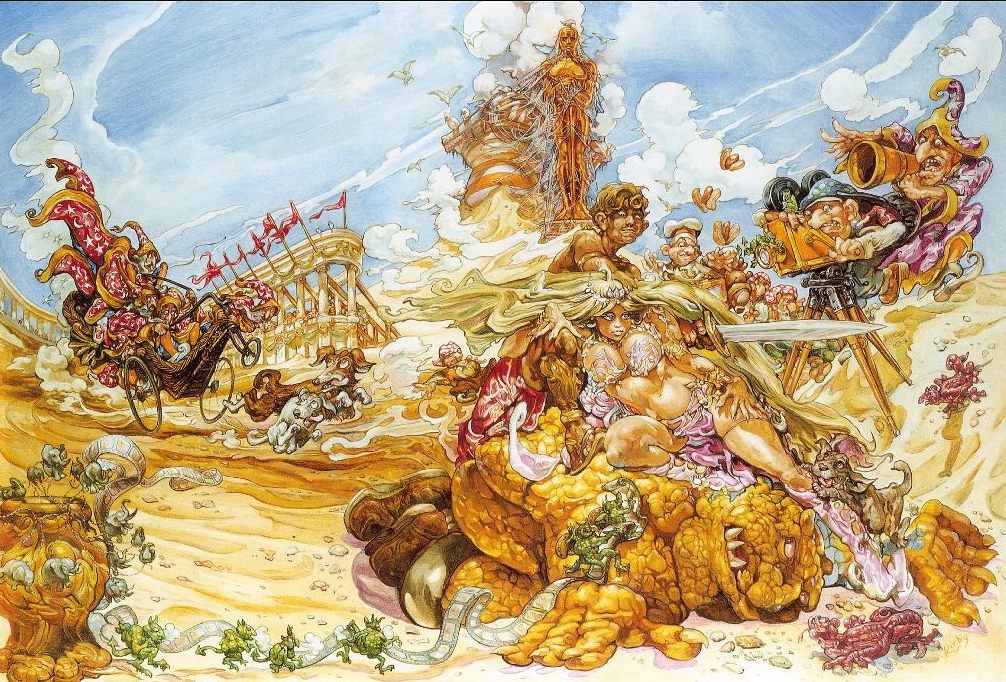
A Book Review: Moving Pictures by Terry Pratchett (Discworld #10)

Movies, almost everyone likes movies. Movies are powerful ideas that can shape realities if people believe in it. Here is an excellent example showcasing how a movie can direct people's lives. In 1986, Top Gun hit the cinema. Starring Tom Cruise, this action movie depicted the life of a fighter pilot as something dashing and romantic. Top Gun smashed the box office, it was a massive success and it entranced legions of young men with high flying dreams. After the movie's release, US Navy reported a 500 percentage increase in the number of young men joining US Navy to become aviators!

Indeed, movies are ideas with real powers. Movies can tell us how to behave, what to say, and how to dress. I think movies have more profound influences in our lives than we are aware of. Yet, the question is, how do we know ideas from movies are truthful?

In Moving Pictures (the 10th Dsicworld novel), Sir Terry Pratchett explored the movie industry via a satirical fantasy story. This is a very interesting book. After I finished reading this book, I went away and thought about it for a few days. Today, I offer to share my opinions about this book in a brief review.

Synopsis:

In the century of Fruitbat, 3 alchemists from Ankk Morpork blew up the hall of their building for the nth time. They finally decided the business of turning lead into gold just doesn't work. Instead, they accidentally invented an alternative way to make gold. What have they invented? Something new has appeared under the sun. Motion pictures has come to Discworld, and it paved a highway to Holy Wood, a highway glittering with gold and alive with dreams of fame.

Holy Wood called for all to dwell in the magic of the silverscreen.

Victor Tugelbend, a reluctant, would-be wizard answered the call of Holy Wood and decided to have a career change. Victor wanted to be a star, just like thousands of would-be actors/actresses like him, chasing Holy Wood dreams.

In a few months, Holy Wood transformed from a no-man's land into a buzzing town. Moving pictures got made, spellbound Ankh Morpork audiences both young and old. The magic of Holy Wood stirred everywhere, spilling over the limits of the universe into realities; the could-have-beens, the-might-bes, the never-weres, and raging ideas of all sorts and kinds. It blended these ideas into a soup of chaos, ready to drown Discworld into oblivion. However, a spark of hope remained alight with two unlikely heroes and a heroine. Our heoric trio is made up of Victor, Gaspode the Wonder Dog, and Ginger. Together, they must bring order back to Discworld before Holy Wood's magical tentacle reaches from the Great Beyond into reality, destroying all...

My thoughts on this book:

Moving Pictures marks the beginning of the Industrial Revolution series in Discworld. This is a true “stand-alone” novel in Discworld library. This also means, Moving Pictures may be a good entry point for new comers to Discworld. In Moving Pictures, Terry Pratchett wrote an excellent parody that is both funny and entertaining. The theme of this book, however, grabbed my attention the most. Before I talk about the theme in this book, let me first talk about what I liked and disliked about the book itself.

On the surface, Moving Pictures appears to be a parody for the conventional fantasy genre. This book made tons of references to pop culture icons; from famous cinematic sequences to memorable movie quotes, all the way to Lovecraftian literature (if you are a Lovecraft fan, then laughter will surely visit you from the first page to the last). I had a lot of fun spotting Easter Eggs while reading this book. I think this book will appeal to lovers of movies.

In terms of characterization, Moving Pictures follows the hallmark of Discworld, featuring a cast of eccentric, comedic characters who are bound to impress readers with their colorful personalities, characters who were brought to life by Terry Pratchett's vivid writings. Victor Tugelbend, a student wizard, played the role of main protagonist in this book. While Victor is a likable character, but Gaspode the Wonder Dog (arguably the second protagonist) is the true star in this book, who stole the spotlight from Victor. Meanwhile, Moving Pictures' third protagonist, Ginger (AKA Theda Withel the actress), provided an interesting reflection about the nature of fame. This book also enlisted a cast of supporting characters to tell its story, most of them are returning characters from other Discworld books. A few of these supporting characters played pivotal roles in this book, one such character being Cut-Me-Own-Throat Dibbler, who appeared in various Discworld novels but never had a major role. In Moving Pictures, Cut-Me-Own-Throat Dibbler is a centrepiece to the story, providing readers an opportunity to explore this well known Discworld personality.

Having said this, there are a few drawbacks in Moving Pictures. I found the story in Moving Pictures disjointed at certain places. Especially in the first 70 pages, where Terry Pratchett constantly switched from one scene to another, and these scenes have no obvious connection to the main story. As a result, I found the early parts in this book slow-paced. However, once the main story began to take shape, it snow-balled at a very fast pace, gathering momentum and building up to a spectacular finale.

As I mentioned earlier, the themes in Moving Pictures captured my interest the most. I think this book, like Small Gods, tells a story set in a strong philosophical backdrop. In this review, I do not wish to spoil the story. Most importantly, I encourage would-be readers to read and think about the book for themselves. This is because after all, the gold of a Discworld book resides in its ability to get people thinking about important issues for themselves. So here I will just briefly offer my personal interpretation for this book. I think Moving Pictures is not just about movies, or the movie industry. After I read this book, I think Terry Pratchett was critiquing the post modern take on ideas and realities. In my opinion, Terry Pratchett seemed to be asking this question: “How do we keep ideas accountable and responsible?” But like I said, this is my personal take on the book. I encourage would-be readers to think about this book and Terry Pratchett's insightful critiques for themselves.

Discworld is a long-running series. It is beloved by millions of readers across the world. These books appeared as parodies of the fantasy genre on the surface, but often explored important issues in our society. In other words, Discworld novels can be seen as social commentaries and they are very, very fun to read. Moving Pictures is a fine example of an excellent Discoworld novel. Sure, this book is not perfect, the story was a bit disjointed at several places and the beginning was a bit slow. But the strengths in this book easily outweighs its weaknesses. Moving Pictures is a stand-alone novel, so this is an excellent entry point for new comers to Discworld. For the veterans of the Disc, Moving Pictures is a must read. I highly recommend this book.


Thursday, October 22, 2015

A Book Review: A Knight of the Seven Kingdoms by George R.R Martin

Drawing inspirations from War of the Roses, A Song of Ice and Fire currently holds the title “rock star” of the fantasy genre. This series attracted a wide readership, telling an epic tale set in a rich, expansive world alive with colorful, vividly portrayed characters. Characters who engaged in power struggles triggered by political storms and court intrigues. Up to date, this series' author, George R.R. Martin, has released 5 books. According to rumors, this series will conclude at book 7.

Four years has gone by since book 5 was released. Yet, the coming of book 6 is no where in sight. While readers around the world eagerly awaits for Mr. Martin to finish writing book 6, in the black of night, a new book has trodden into the stables of our local bookstores. This new book serves as a prequel to A Song of Ice and Fire. This is a tale about chivalry, a tale in three parts. This gorgeous book, is called A Knight of the Seven Kingdoms.

Synopsis:

Songs and poems in Westeros remember Tales of Dunk and Egg. Standing 7 feet tall, Dunk was a naive but chivalrous hedge knight known as Ser Duncan the Tall. What Dunk lacked in skills and finesse was compensated by his towering height and brute strength. Riding along Dunk was his squire, Egg, a peculiar looking boy of 10 with a shaved head, whose true origin, if revealed, was bound to attract white hot attention as luminous as the light reflecting off his bald head.

Riding on the backs of their steely mounts, this knight-squire duo tread the seven kingdoms of Westeros. They journeyed from the searing deserts of Dorne up to the frozen Wall in Winterfell, where extra-oridnary encounters prepared them for an extra-orindary destiny.

My thoughts on this book:

Firstly, I wish to draw people's attention to the artworks in this book. A Knight of the Seven Kingdoms is a beautiful book. Publishers don't usually make beautiful books like this one anymore. 160 illustrations, drawn by award-winning artist Gary Gianni, accompany the texts in this book. I think book illustration is a dying art. These days, when you buy an “illustrated book”, you will be lucky to see 3 or 4 black and white illustrations in it. A Knight of the Seven Kindgoms, however, is lush with beautiful illustrations. Even if you have already read Tales of Dunk and Egg, I would still recommend getting this book for its artistic values. ( In my review article, I attached a few illustrations from the book as examples)

In terms of its contents, A Knight of the Seven Kingdoms collects three novellas; The Hedge Knight, The Sworn Sword, and The Mystery Knight. These novellas follow the adventures of Dunk and Egg in the chronological order. Each novella measures approximately 120 pages in length, so naturally they do not feel as epic as A Song of Ice and Fire novels. However, these novellas do have charms of their own, and George R.R. Martin wrote briskly and powerfully in this book.

The most valuable and interesting aspect in this book, in my opinion, is that we are finally getting the perspectives from the common people in Westeros. Let me explain; A Song of Ice and Fire novels narrate the story from the perspectives of high lords and ladies in Westeros, who were major players in the power struggle for the Iron Throne. A Knight of the Seven Kingdoms, on the other hand, narrates the story from the perspectives of common people. In this book, readers explored the bleak and violent world of Westeros, and its ongoing, political-military conflicts through the eyes of Dunk, an orphan who crawled out of Flea Bottom to become a humble hedge knight. Dunk reminded me of Brienne of Tarth, who is one of my favorite characters from A Song of Ice and Fire series. 


Furthermore, Dunk has an interesting, and at times, heart-warming relationship with his squire, Egg (whose true identity I will not reveal here). I really enjoyed reading their adventures. Meanwhile, the stories also featured a cast of supporting characters; varying from farmers, village merchants to lowly soldiers, these character gave readers insights into how “normal folks” in Westeros viewed the ongoing power struggles waged by their rulers.

A Knight of the Seven Kingdoms is meant to serve as a prequel to A Song of Ice and Fire series. Without spoiling the story, let me just say this book shed light into the background history of some major houses in Westeros. If you are a fan for A Song of Ice and Fire, then A Knight of the Seven Kingdoms is a must read for you.

I really liked A Knight of the Seven Kingdoms, the 3 stories from this book are ripping yarns. George R.R. Martin portrayed both Dunk and Egg so vividly that they struck me as two of the most memorable characters in the saga of Westeros. Those who are fond of A Song of Ice and Fire novels will definitely like this book. If you have yet to read A Song of Ice and Fire novels, then this is probably a good entry point to start reading the series. I also think this book deserves a spot on a fantasy lover's bookshelf. It is worth owning for Gary Gianni's beautiful artworks alone, and the price for this book is quite reasonable considering its good quality. Until that day when Mr. Martin finally unleashes The Winds of Winter upon us, A Knight of the Seven Kingdoms will quench your thirst for adventures in Westeros.


Wednesday, October 14, 2015

A Book Review: Rosemary's Baby by Ira Levin

Roman Polanski's cinematic masterpiece, Rosemary's Baby, ranks number two on my list of "favorite horror movies of all time". Interestingly, the movie is based on a horror novel of the same name, written by Ira Levin, an American novelist, playwright, and songwriter.

I have always wanted to read Rosemary's Baby the novel, but I never had the chance. For some reason, my local library does not collect Rosemary's Baby, despite it being a horror novel of the same caliber as Stephen King's Carrie and The Shining. My chance to read Rosemary's Baby finally arrived, when I scooped a copy of it from a bargain sale at a bookshop. I bore this book home, and read it in a gusto.

How does Rosemary's Baby the novel compare to Roman Polanski's movie adaptation? Today, I would like to review this novel. Firstly, let me provide a synopsis for this book.


Synopsis:

New York, 1965.

Rosemary and Guy Woodhouse were just like any other young couple. Dreams and aspirations decorated the wall of their bright future. Guy was an ambitious actor, searching for a breakthrough role so he could kick start a fruitful career in acting. While Rosemary was a young housewife dreaming of having children and building a beautiful family. Together, Rosemary and Guy moved into Bramford, an old New York apartment building, styled after the fashion of Gothic Revival.

After Rosemary and Guy settled into their stylish apartment, they received special attention from an elderly couple living next door, Minnie and Roman Castevet, who showered Rosemary and Guy with overwhelming cares and hospitality.

“It's almost too good to be true”, thought Rosemary. Or perhaps, things were really too good in Bramford to be true? What dark, sinister motives could be lurking behind the warm and smiling faces of their friendly neighbors?

My thoughts on this book:

I like Rosemary's Baby (the novel) as much as the movie adaptation. Now that I have read the novel, I must say the movie stayed very faithful to the book, there aren't many differences between these two versions. Having said this, reading this book is still valuable. This is because the book shed light into Rosemary's personal thoughts and emotions that could not be easily depicted in the motion picture. In other words, while Roman Polkanski's movie adaptation is a visually striking, cinematic masterpiece, but reading the novel warrants a deep insight into the mind of the character. In fact, this probably applies to all movies adapted from novels, they are two mediums for telling the same story, each has its own merits, so they should be appreciated from different perspectives, and evaluated on its own term.

As for the novel itself, it is very short. Counting to 230 pages, Rosemary's Baby is a quick read. This atmospheric story moves at a very fast pace, and the writings will surely immerse readers in an ocean of suspense. Rosemary's Baby is simply one of the most unconventional horror stories ever told. The horror in Rosemary's Baby is not build on spooks or scares. Instead, this book sends waves of terror down your spine in the wake of paranoia. A paranoia that not only drives the plot forward but is also rich in symbolism.

Indeed, other than being an entertaining novel. The greatest value of this book is perhaps, it's symbolism, allegorizing the theme about “control”. Under this theme, the book explored the challenging topic about women's health in our contemporary world. This is a book about cultural progress, not only did the theme reflect the social-politcal clime in 1960s, but it is still relevant to our 21th century world. Here I leave would-be readers to explore the interesting symbolism in Rosemary's Baby. However, I would like to say, this is the kind of book that deserves multiple readings, where a reader may discover new things upon a second, or the third reading.

Overall, I think Rosemary's Baby is an excellent novel. This book is still worth reading even if you have already seen the movie. If you have not seen the movie or read the book, then I highly recommend both versions to you. Rosemary's Baby is the most unique tale of horror ever told in the genre, and this book will intrigue you with thought-provoking allegories, exploring topics that are still relevant for our world today.


Saturday, October 10, 2015

A Book Review: Abhorsen by Garth Nix (Old Kingdom #3)

Abhorsen is the 3rd, and the final book in Old Kingdom trilogy, a series of award-winning, YA fantasy novels. This trilogy's author, Garth Nix, is an Australian novelist who resides in Sydney. In the past two decades, Old Kingdom trilogy attracted readers of all ages, from the young and the old. I began reading this trilogy upon the recommendation from Goodreads, and I enjoyed the first two books. Therefore, with great anticipations and excitement, I journeyed into Abhorsen, the concluding chapter in this trilogy. Here are my thoughts about this book.

Synopsis:

A terrible legend in Old Kingdom sings a song about a turbulent time in history, a time when Orannis, also known as The Destroyer, fought The Seven at the beginning of time and lost. The Seven bound Orannis, broke him in two, and buried him deep in the bowel of the earth. There, Orannis and his lust for destruction was to be imprisoned for eternity.

However, this Old Kingdom legend is about have a new chapter. Hedge, a loyal servant of Orannis has been hard at work to free him from his subterranean prison, and Hedge is on the verge of success. Should Orannis be restored, unprecedented destruction will visit the world.

The burden of stopping Orannis falls on Lirael, the new Abhorsen-in-waiting, who must figure out a way to prevent Orannis from being restored to his full power. The problem is, Lirael has no idea how to begin this quest. Together with her faithful friends, Lirael sets out on a mission, racing against time to stop Orannis before all life is destroyed.

My thoughts on this book:

Abhorsen brought Old Kingdom trilogy to a satisfying conclusion. The characters are very well developed in this book. Furthermore, this book, like both of its predecessors, knits its chapters together closely and tells a fast paced story. Suspense and actions populate this book, and readers will encounter many nail-biting moments. Yet, what separates Abhorsen from a “conventional and entertaining” novel, is its overarching theme about death, which is captured in a quote that appeared several times in this trilogy:

“Everyone and everything has a time to die”

In Abhorsen, Lirael and Sam, both protagonists in this book, had to constantly deal with losses and deaths of both innocent people as well as their loved ones. However, unlike conventional fantasy novels, Abhorsen (and this trilogy overall) does not treat death as a bad thing. Rather, the overarching theme in this trilogy argues that loss builds one's character, and that through dealing with losses and making sacrifices we grow and mature. Abhorsen fleshed out this theme when its concluding chapter brought the story to a touching end. I do not want to spoil the story, so let me just say, the ending of this book was solemn yet joyous. Abhorsen imprinted a bitter sweet memory on my mind long after I closed this book.

The second recurring theme in this trilogy explores the idea of destiny. Ok, at this point, you are probably thinking, “oh, so it's the cheesy plot device about a chosen one with a great destiny again?” If this is your concern, then I tell you there is no need to worry, because Old Kingdom trilogy uses the plot device of “destiny” in a refreshing way that is believable and meaningful. The theme about destiny is captured in this quote, which recurred throughout the trilogy:

“Does the walker choose the path, or the path the walker?”

What a thought-provoking quote, right? I do not think there is a “simple and correct” answer to this question. However, here I offer to share my take on this quote based on the context of the story. This book's two protagonists, Lirael and Sam, were adolescents entering a phase, a stage where they were trying to find personal identities and figuring out their places in the world. However, life forced them to take up responsibilities, leaving them with one option; making the best out of the circumstances they were given. Then by doing that, in turn, they found their identities and places in the world. Personally, I think the theme in this book is particularly relevant and meaningful for young adult readers.

There are so many things in this book I can talk about, but I think my review should have provided sufficient information, giving you some insights about this book (and the trilogy in general). Overall, I recommend Abhorsen to those who have already read the first two books in Old Kingdom trilogy. Meanwhile, I also recommend Old Kingdom trilogy to those readers who are lovers of fantasy fictions. I enjoyed reading Old Kingdom trilogy, should you venture into this trilogy, then I wish you will discover the magics in these novels and enjoy them as much as I did.

Until the next time, happy reading!