Saturday, November 8, 2014

Movie Review: Interstellar

  Space, the final frontier for the human exploration. From our home, the 3rd rock from the sun, mankind stares into the black infinity of the space, marveling at the stunning sights of the celestial bodies, and wonder what is our place among the stars; “what is out there?” “Are we alone”? These inquiries have inspired many of our most celebrated technological inventions up to date. When Apollo 11 landed on the moon in 1969, this pivotal moment entered the river of history, as a giant, forward leap of the human evolution on earth. From that day and onward, mankind demonstrated our ability to leave the planet that gave birth to our species, to explore other worlds. Most importantly, we proved that we can survive out there.

Since then, powerful nations around the world have poured billions of dollars to further the pioneering of space exploration. Today, some have voiced their opinions, criticizing space exploration as a waste of valuable resources. However, what if one day, the continuous survival of our species can only be ensured by our ability to expand our existence onto other worlds? Director Chris Nolan, constructed a science fiction movie based on this hypothetical scenario, in a 2014 movie called Interstellar. This movie was rumored to bear reminiscence to the 1968 sci-fi classic, 2001: A Space Odessey. I have been waiting to see Nolan's space opera, since its announcement at the beginning of this year. On Friday, this movie was finally released in the cinema, and I was able to attend a screening of this film with eager anticipation. Today, I would like to provide a review for this movie:

Synopsis:

Cooper, a widowed father of 2 children, former NASA test pilot and an engineer, is a man with big dreams but born in the wrong time. In his time (in the future), the earth is no longer able to sustain humanity. Dust storms plagued the earth, destroying valuable food resources such as crops. The once flourishing human civilization transitioned into a dying, agrarian society, with a main focus on producing food resources.

Cooper chanced upon a discovery, where he came upon a secret NASA installation led by Professor Brand. Hiding from the eyes of the public, Brand and his team have been secretly working on a ground-breaking project. A project of paramount importance, it is the final hope for the continuous survival of mankind. Should this project bear fruition, then mankind will survive the dying earth, stepping into an interstellar future.

What I think about this movie:

I am uncertain what to say about this movie. I like most of the movie, but there are some places that I just couldn't appreciate. For starters, I found this movie fascinating, because it is mostly based on the idea of Einstein Rosen Bridge (wormhole). Meanwhile, many interesting scientific theories, such as relativity (and the twin paradox), singularity, gravity etc.. all served as fabrics, to be weaved and integrated together, forming a very clever plot.

Secondly, the technologies shown in this movie are actually believable. For example, the design of Cooper's spaceship is based on the design of the international space station, one that can simulate artificial gravity, allowing a fitful environment for astronauts to endure an extended period of stay in the space, without loosing too much bone mineral density and muscle strength. Furthermore, this movie is beautiful to look at. It is packed with breathtaking, stunning images of the celestial bodies, from a jaw dropping view of a black hole, to some intense scenes of wormhole travel, coupled with a constant note, resonating the vastness of the universe in the movie's background, this movie is a true visual spectacle to behold.

However, this movie is not just about showing beautiful images of the universe and introducing scientific theories. At its core, Interstellar is an emotional story about the spirit of human perserverence, triumphing against seemingly impossible odds. It is also a story about the human condition, the fears and love for one another, our failed dreams and how we deal with them, to find other ways to appreciate life. These themes are commonly shared across a spectrum of human experiences. Personally, I can somewhat resonate with Cooper's situation, because I too, have invested a lot of time and energy, to gain training and education in what was to be my dream, but unable to put my trained skills into practice due to the lack of opportunities in that field, and I was forced to turn to the next best widow of opportunity to go about life, learning what it is to find joys from contentment, realizing we are more than our professions.

However, while I agree a good story is usually based on the reality of the human experience, but unfortunately, this is also where the story of Interstellar over-extended itself a bit, especially in the last 20% of the film, leading to a somewhat far-fetched, disappointing finale. Having said this, the first 80% of this film is superb, with a well knitted story portrayed by stunning works of cinematography, based on interesting science. This is a movie that bears resemblance, in both tones and atmosphere, to the classic sci-fi movie, 2001: A Space Odyssey.

My second item of complaint about this movie, is the loud volume of background music. I found the volume of these background music too loud, not only does this become annoying, but many times I struggled to hear the dialogues exchanged between the characters on top of the soundtracks. This happened several times in the movie, and it is especially frustrating if you miss the critical dialogues (for example, I could not hear the narrations at the end of the film, because the volume of the soundtrack was too loud, and it interfered with the narrations, so I had to find it from Google after I came home from the movie).

After I watched this film, my opinion is that while Interstellar did not meet my expectations, it has flaws, but it is still a good movie. I think this movie is a visual spectacle, deserving to be seen in the cinema, where we can bear witness to the awesome grandeur of our universe, on a big, silver screen. The last 20% of this movie felt somewhat flat and uninspired, but its attempt to depict an emotional drama about the human condition, is partially (if not mostly) successful.


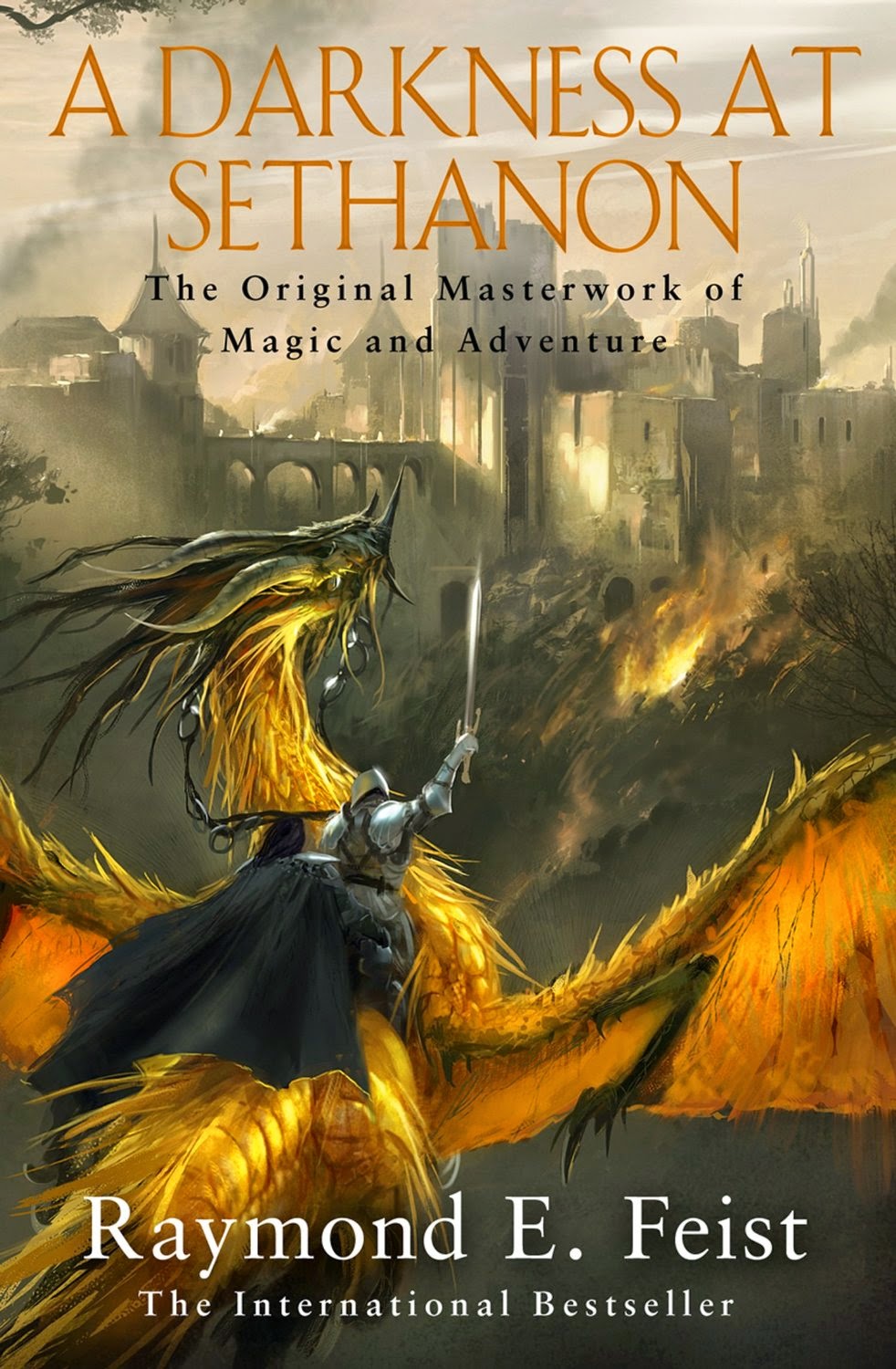
Book Review: A Darkness at Sethanon by Raymond Feist (Riftwar Saga #3)

A Darkness at Sethanon is the final book to Raymond Feist's epic fantasy trilogy, Riftwar Saga, which was launched with the phenomenal success of its first book, Magician. The general consensus among readers is that Magician is the best book in this trilogy, where its sequel, Silverthorn, while being a good book, is a much weaker book in comparison. A Darkness at Sethanon continued the story that started in Silverthorn, bringing a conclusion to this trilogy. After reading A Darkness at Sethanon, I think this is a really good book, and it concluded Riftwar Saga in a most spectacular fashion. Today, I would like to provide a review for this book.

Synopsis:

Kingdom of Isles has enjoyed one year of peace following Prince Arutha's quest for Silverthorn. A conspiracy shattered this peace, when a mysterious assassin appeared at the royal court during the celebration for the birth of Arutha's two sons. The death cult known as Nighthawk, has returned!

The climax for Riftwar Saga approaches, as Arutha journeys north with his friends, to confront Murmandamus for one last time. Battles would be waged, cities and lives would be destroyed. Sagas and songs will remember the deeds of bravery and courage in the river of history. However, Arutha and his friends have yet to realize, that they are fighting a war where a victory cannot be secured by the might of mortal man.

Meanwhile, Pug and Tomas are engaged in a perilous quest, crossing the barrier of space and time, to search for Macro the Black, who happens to be the only person with the knowledge about Murmandamu's master. Should they fail this quest, not only will Arutha loose the war against Murmandamus, but every life on Midkemia, will surely perish.

What I think about this book:

I think A Darkness at Sethanon provided a fitting conclusion to Riftwar Saga. This book and Silverthorn, are essentially one book. Raymond Feist stepped up a notch in his storytelling, packing it with more actions and dramas in this book than in Silverthorn. A Darkness at Sethanon is split into two storyline; Arutha's final showdown against Murmadamus, and Pug and Tomas' quest to search for Macro the Black. These two, seemingly separate plots are packed with dramas, epic in scope, crescendoed to a final converging point at the climax of the story. Although this book is not as long as Magician, but it is almost an equal to Magician in terms of scope and contents. In other words, A Darkness at Sethanon almost reciprocated the epic feel in Magician.

Riftwar Saga is often marked by its memorable characters. A Darkness at Sethanon, is no exception to this hallmark. This book is supported by a cast of impressive characters. Readers will reunite with past favorites such as Arutha, Pug, Tomas, Amos Trask, Jimmy the Hand, Martin Longbow, Baru etc.. while also meeting a somewhat new, superbly crafted character, Guy du Bas-Tyra. Guy made a very brief appearance in Magician as an antagonist, but this character was never explored in depth. In A Darkness at Sethanon, readers would meet Guy, as the story finally explained his motivations and his past. From here, Guy became one of the pivotal characters in the story. Without spoiling the plot, let me just say, I think many readers will like Feist's portrayal of Guy, and the role he played in this book.

Pug and Tomas also returned as central characters in this book. Half of the book revolves around their quest to search for Macro the Black. I think this part of the book is very interesting, because Pug and Tomas' quest involved traveling across both space and time, giving off a vibe of science-fiction which is atypical in the fantasy genre. I think Feist managed to capture the mind blowing strangeness of space/time travel from science-fiction, and masterfully grafted it onto a medieval themed, fantasy novel. With grand narratives and vivid portrayals, Feist depicted several breathtaking scenes about the grandeur of the universe.

Furthermore, I also like how Tomas, as a central character, was finally given something important to do in the story. Allow me to explain, in Magician, the story detailed the journeys of how Pug and Tomas became the most powerful entities in the world of Midkemia, i.e. while Pug became a powerful wizard through training on another world, Tomas became a mighty warrior who inherited the strength of a long vanished, ancient race known as Valheru. Afterward, in the ensuing story, Pug was designated to face obstacles that challenged the limit of his power in several pivotal moments. Meanwhile, the same cannot be said about the treatment for Tomas. Instead of setting up real challenges for Tomas, Feist used Tomas as a deus-ex machina solution in Silverthorn. As a result, inevitably, one will feel that even though Feist spent a great deal of time building the character and story of Tomas in Magician, but he didn't do much with it afterward, and it is a waste of potentials. Thankfully, in A Darkness at Sethanon, Tomas is finally given difficult, and important obstacles to overcome, pushing his strength to the limit, while pitting him against powerful foes.

I enjoyed reading A Darkness at Sethanon. This book is packed with all elements that made the fantasy genre great. In my opinion, this book brought Riftwar Saga to a satisfying conclusion. All mysteries, plots, and sub-plots are neatly tied up. I did not find a dull moment in this book (and this series in general), from page one to the last, I was constantly immersed in the story, savoring every moment of it as the story unfolded at the turn of every page. If you are a fan of fantasy fictions, but have not read Riftwar Saga, then I would highly recommend this series to you, and I envy you, because you are about to discover its charm for the first time.


Tuesday, November 4, 2014

Book Review: Silverthorn by Raymond Feist (Riftwar Saga #2)

  After I discovered the treasure that is Magician, I paddled on, and read the second book in Riftwar Saga by Raymond Feist, titled Silverthorn. In terms of the sizes of these books, Silverthorn is only 380 pages, not even half as long as Magician which is 840 pages. The general consensus from Goodreads (and from other book review sites), is that Magician is the best book in Riftwar Saga. In fact, a few people even claimed that Magician is the best book Raymond Feist has ever written. As a result, I lowered my expectation as I ventured into Silverthorn. Yet, the question remains, even if Silverthorn cannot fully re-create the charms of Magician, does it stand up as a worthy sequel to Magician? Let's find out.

Synopsis:

Following the events in Magician, the Kingdom of Isles enjoyed one year of peace under the reign of her new king, Lyam coDoin. While his younger brother, Arutha, ruled as the Prince of Krondor. More blessings greeted the already peaceful kingdom, when Prince Arutha and Princess Anita announced the news of their engagement.

Tragedy struck at Arutha and Anita's wedding ceremony, when an assassination attempt left Princess Anita wounded by a deadly, poisonous dart. To save his beloved, Arutha must discover the cure. Old and new friends joined Arutha on this mission, as they set out on a race against time, to uncover the cure to the poison. However, our band of brave heroes could not have foreseen, that their quest would unveil a sinister plan at work, manipulated by an ancient, dark power seeking to dominate Midkemia.

What I think about this book:

I was surprised at how good this book is. Perhaps this is because I lowered my expectations for Silverthorn after reading various book reviews. In my opinion, I do think Silverthorn is not as charming as Magician, because not only is this a much shorter book, but the scope in Silverthorn is also much narrower than in Magician. In other words, while Magician gave readers a very “epic” feel, Silverthorn feels like a much narrower, specific story. Instead of having a storyline that spanned over a decade like in Magician, the story in Silverthorn took place over a much shorter period of time.

Another major difference between Magician and Silverthorn is, while Magician had a theme that's not common in fantasy fictions, the theme in Silverthorn is a one that is more typical to a novel in the fantasy genre. i.e. At its core, Silverthorn is a quest story, where a band of heroes travel to a certain location to fulfill a mission, while combating the minions of a dark lord. Furthermore, unlike Magician, Silverthorn is not a stand alone novel. The ending of Silverthorn has a cliffhanger, where the story would be completed in the final book in Riftwar Saga.

Having said all of these, I still think Silverthorn is a good book. While it is not in the same league as Magician (but again, not many fantasy novels are as good as Magician), still it spellbinds its readers with its own strengths. For starters, Silverthorn is supported by a very strong cast of characters. Not only do readers meet returning characters such as Arutha, Lyam, Martin, Pug and Tomas, but this book also introduced a very interesting, new character called Jimmy the Hand. He is a witty, young thief who became a loyal friend to Arutha, and provided invaluable aids to his quest. The story in Silverthorn is much darker than in Magician, but Jimmy's occasional, witty humor certainly brightened up our heroes' perilous journey. I really like Jimmy the Hand, I think he is a fun and interesting character, and I can't wait to see more future stories featuring Jimmy.

Feist also did an excellent job at creating mysteries and suspense in the story. Several plot twists and mysteries unfolded gradually as the story progressed, and the suspense was gripping enough to keep me guessing throughout the whole book. I was surprised by several unexpected twists and turns in the story. While reading this book, I never knew what to expect in the next chapter, although at the back of my mind, I knew our heroes weren't going to endure any permanent harms in the story, but I still felt a real sense of danger for the characters anyway.

The scope of Silverthorn is nowhere as grand as in Magician. Nevertheless, Feist still jam-packed a lot of story elements and sub-plots into Silverthorn. Despite the large amount of contents in this book, it never became convoluted, and it was really easy to follow the story. Feist seem to be a master storyteller who is able to spin a yarn loaded with contents, yet still tell it in a most simple, unconfused way; complex but not complicated. The pace of the book flowed smoothly, I cannot recall a single, dull moment while reading this book. When I turn to the last page of Silverthorn, I was eager to start reading the next book.

I enjoyed reading Silverthorn. While it may not be as epic and charming as Magician, but Silverthorn has its own unique beauty, enchanting its readers. It has a very strong cast of characters, and a gripping story to warrant a fun, enjoyable read for lovers of fantasy fiction.


Saturday, November 1, 2014

Book Review: Magician by Raymond Feist (Riftwar Saga #1)

  There is a list for books called The Big Read, this is a survey carried out by BBC in 2003, to find the most beloved novels in the UK of all time. There are 200 books on this list, very few of them are fantasy novels, written by famous practitioners of the genre such as; Terry Pratchett, J.R.R Tolkien, J.K. Rowling, Philip Pullman, and C.S Lewis. At number 89 of this list, is a fantasy novel called Magician, written by Raymond Feist,.

When Magician was published in 1982, it was an instant success. Based on this success, Feist expanded the storyline and wrote 2 more books, and the trilogy is collectively known as Riftwar Saga. When Magician was published, it defined what the fantasy genre was going to be for the next two decades, at least until the recent arrival of “grim dark” fantasy such as A Song of Ice and Fire and The Malazan book of the Fallen, in the 21th century.

I guess this means, a 21th century reader may expect Magician to be a typical fantasy trope tumbling with cliches. This is why I did not read this book until recently, when Magician (and the rest of Riftwar Saga) were published with new covers. I really like the artworks on these new book covers, so I purchased the entire trilogy (yes, I confess, sometimes I buy a book based on its cover). After I read Magician, I have to say this is an excellent book, but most importantly, I was really surprised by this book, because it proved my expectations for this book were completely off the mark.

Today, I would like to provide a review for Magician.

Synopsis:

Kingdom of Isles has enjoyed two decades of peace, one of its frontier cities, Crydee, is ruled by Duke Borric, the third most powerful man in the kingdom. Our story began at the city of Crydee with two boys, Pug, and his best friend Tomas. Pug was an orphan, a kitchen boy at Duke Borric's castle, while Tomas was the son to the master cook at the castle. When they came to age, Pug became an apprentice to a master magician, his friend Tomas became an apprentice to the duke's sword master.

An otherworldly, mysterious shipwreck landed at the coast of Crydee. Out of curiosity, Pug and Tomas arrived at the scene to investigate the alien wreckage. What Pug and Tomas discovered at the wreckage whirled them into a tornado of conflicts, a war waging across a rift that tore through the fabrics of time and space. Here began an epic adventure, where a kitchen boy is destined to become the most powerful magician ever lived, and the fates of two worlds will be changed forever.

What I think about this book:

I love Magician. I regret not having read this book sooner than later. As I have mentioned earlier, when Magician was published in 1982, it defined the fantasy genre for the next two decades. Therefore, it does have story elements that would be deemed as cliches by modern day readers. For examples, not only do elves, dwarfs and goblins appeared in this book, but the story hinged on the journey of two seemingly unimportant boys, as they gradually transitioned into mighty heroes who would eventually save the world. This kind of story elements have almost taken the status of permanent residency in the fantasy genre, especially in fantasy novels from the 80s (such as The Belgariad by David Eddings).

However, at the same time, Magician also surprised me. Yes, this book does have elves, dwarfs, and goblins. Yet, unlike most fantasy novels, these magical creatures have very little to do with the main story. Furthermore, while the protagonists are two boys becoming mighty heroes to save the world, but the story of Magician is also refreshing, and in many ways, it is unique because it is not a typical good versus evil yarn. Neither is Magician radiating auras of moral ambiguities (A trademark of “dark grim” fantasy). Instead, what makes Magician unique and refreshing, is at its centre, it is a story about the clash of cultures. Not just a clash between the old culture against the new one, but it is also a story about two, totally different cultures colliding heads on against each other, presiding over a conflict of interests.

Let me explain (minor spoiler alert here), in Magician, the story revolves around a war, waged across a rift that tore through time/space, bridging two worlds together. On one side, we have the protagonists who are denizens, and defenders for Kingdom of Isles, which is based on a culture resembling the medieval, European influence. On the other hand, we have the invading Tsurani forces, they resemble a pseudo Samurai, feudal Japanese culture. In this book, the invading Tsurani forces played the role of antagonists, but as the story unfolds, readers gain an insight into the Tsurani world, where the book explored the motivations behind the Tsurani invasion. And just like most real life wars involving 2 nations, there are good and bad people fighting on both sides. Meanwhile, the conflict may be resolved by improving the old culture with an integration, and an understanding of the new one. This book weaved the theme of a cultural clash into its essence, depicting the complexity and the dynamics of a cultural clash thoughtfully, it is unique and refreshing in that it did not inherit the typical fantasy trope such as a quest against an evil overlord (minor spoiler alert ends here).

Magician is also vast in its scope. The story spanned over almost a decade, where more than a handful of characters appeared in this book. All characters are very likable, portrayed vividly with memorable qualities. Feist included a titanic amount of story elements, and subplots into this book, but it is marvelous that with this amount of content, this book never became convoluted. Despite it enormous scope, the story was extremely easy to follow through. The story flowed at a very good pace, it is fast enough such that there is not a dull moment. Yet, the story is not told in haste, allowing readers to explore the world and the characters in great details, savoring the rich background and the atmosphere in this book. This book can truly be described as “epic”, in a good way. I was really impressed by how Feist managed to fit a story of this scope into one book, and still kept the story exciting, concise and easy to follow. I mean, usually a story of this scope would be released in the format of a series, but Feist managed to put everything into one book at 800 pages in length, so that at the end of Magician, all plots and subplots are neatly concluded, and it is pretty much a stand alone novel by itself.

After I read Magician, I have decided to add this one to my personal list of favorite books. This book is vast in its scope, and rich in the story, blended with an interesting theme that is atypical to most fantasy novels. I have read many fantasy novels, and many times in the past, I felt a sense of relief when I finished a book. Magician, however, is not one of those books, I felt refreshed after I read this book instead. In fact, reading Magician turned out to be a rare occasion when I wished a book would never end, and was sorry to see the last page, wishing for more. In my opinion, I think Magician is a “must read” for any lovers of fantasy fictions, don't miss out on this one!


Saturday, October 25, 2014

Book Review: The Power that Preserves (The First Chronicles of Thomas Covenant the Unbeliever #3)

 Does morality matter to each of us, at an individual level? Or does morality only matter if our beliefs in (and about) this world are real and true?

As I turned to the last page of The Power that Preserves, the final book to The First Chronicles of Thomas Covenant the Unbeliever, I walked away, feeling inspired to further explore this dynamic question. Most importantly, I just can't believe that despite a troublesome start at book 1, book 2 and 3 managed to turn around and grabbed my interest. I am so glad I persevered with this series after the first book, and read the entire trilogy. Today, I would like to review The Power that Preserves, this book provides a satisfying conclusion, to this very unique fantasy epic.

Synopsis:

Thomas Covenant has been twice summoned to the fantastic world of the Land, to aid the Lords at Revelstone, and combating the tyranny of Lord Foul, who is the physical incarnation of Despise.

However, Thomas Covenant found it hard to believe his experience at the Land was real. As a result, Covenant was reluctant to aid the Lords in their quest. Furthermore, Covenant's unbelief behaves as a double edged blade, cutting both ways. While his unbelief occasionally thwarted Lord Foul's advance, but his unbelief, leading to inaction, also harmed many people who came across his path in the Land.

Now, Covenant has been summoned to the Land for the third time. Upon his arrival, he found 7 bitter years has passed in the Land. During these 7 years, Lord Foul has mastered the power of Illearth Stone, and had become even more powerful through some mysterious, devious means. With his great power, Lord Foul brought an ever-lasting, harsh winter upon the Land, murdering this once fantastic world and its populace with blood chilling claws of icing death. Covenant is the Land's last hope to stop Lord Foul, he must discover, the power to preserve.

However, Lord Foul is the incarnation of Despise. What power can defeat Despise?

What I think about this book:

While The Power that Preserves provides a satisfying conclusion to this trilogy, but it is not a flawless book. I found the pace of the book uneven, and I felt this book would have been just as good, if it was shortened by 50 pages. This is because Stephen Donaldson's writing style is verbose, and the use of vocabulary in this book (and this series in general) is overly expansive. My opinion is, while this type of writing style does weave an atmosphere of intelligibility around this book, but after a while, a reader may find, that deciphering Donaldson's writings prove to be a nuisance than a stimulating exercise.

Having said this, I must say, that the style of writing in this book (and book 2) is still more approachable, in comparison to Lord Foul's Bane, the first installment in this series. However, Donaldson's verbose, flowery writing style hinders the pace of the story at several places, making this book (and the series in general) hard to sit through.

Despite its flaws, I did enjoy reading this book, because I think this book (and the series in general) is probably one of the most interesting creations in the genre of fantasy literature. While this is a story about good versus evil, but in the eye of the storm, it takes its readers on a journey to explore the boundaries of human morality. The protagonist in this series, is Thomas Covenant, a 20th century American author who contracted leprosy at the height of his career and personal life. From there, as a leper, Covenant was shunned and rejected by the society and his family, attached with labels such as outcast and unclean. Then one day he was transported to a fantastic world called the Land, where he was forcibly thrown into a quest to combat an evil overlord. But Covenant's problem was that he did not believe his experience was real, hence calling himself “Thomas Covenant, the unbeliever”. Therefore, just as Covenant struggled with his mounting bitterness and self contempt from his life as a leper, he was also uncertain whether if he should bear the moral responsibilities for his actions (or lack of actions) in what he perceived to be a dream world, making him a reluctant anti-hero. i.e. Covenant was told he had the power to save the Land, but he did not know what that power was, and he lacked the conviction to try to save the Land. As a result, in the previous 2 books, Covenant inevitably hurt many people in the Land because he was reluctant to do anything.

In The Power that Preserves, Covenant was summoned to the Land for the 3rd time. This time, Covenant bore witness to the fruits of his past doings in the land. Lord Foul, the incarnation of Despise, was gradually killing the Land and its people, because Covenant did nothing to help in the past. This is an interesting parallel between Covenant's leprosy which was gradually killing him (bodily and emotionally), and the Land being gradually killed by an evil entity which physically represents despise. Covenant was tormented by the sights of the suffering people due to the inactions of his past, and he was loosing himself just as the Land was lost. In this book, Covenant finally came to the realization, that he had to stand at the eye of the paradox between his unbelief and moral responsibilities, to discover the power that would preserve his very own nature, as well as the Land even if it was not real, because it mattered to him.

In my opinion, this premise made this book (and the series) worth reading for. The final showdown between Thomas Covenant and Lord Foul (AKA Despise) was probably one of the most captivating showdowns in the history of fantasy literature. It revolved around a question that everyone should be able to relate to: How does one defeat despise?

I think The Power that Preserves ended the journey of Thomas Covenant in a grand fashion. Despite the fact I did not appreciate Donaldson's writing style, but I do feel inspired to further explore and expand (or even alter) my current view on human morality. I would like to share here, that personally, as I closed The Power that Preserves, I walked away with a new found understanding, that I should act morally NOT on the grounds that my existing beliefs in (and about) this world are real or true. Instead, I should act morally regardless of any ground, because if I don't, then I cannot be.

Thank you for reading this review.


Saturday, October 18, 2014

Book Review: The Illearth War by Stephen Donaldson (The First Chronicles of Thomas Covenant the Unbeliever #2)

  Does morality only apply to a world that we believe is real?

Stephen Donaldson (perhaps unintentionally) provoked his readers to explore this question, in Lord Foul's Bane, the first book to The Chronicles of Thomas Covenant the Unbeliever. I thought Lord Foul's Bane had an interesting story, but I found it very difficult to read, because Donaldson's writing style was verbose and overly flowery. Yet, I decided to continue with reading this series, because the premise behind the story intrigued me. Furthermore, Donaldson named his fictional hero, Thomas Covenant the Unbeliever. With a name like that (and what it may imply), I thought this series must contain some aspects of significance, for it to have achieved such a wholesome reputation.

At this point, I am happy to report, that I like the second book of this series, titled The Illearth War, ALOT more than Lord Foul's Bane. Today, I would like to provide a review for The Illearth War. If you have read Lord Foul's Bane but is uncertain if you would like to continue with reading this series, then feel free to read on. I hope my review will provide some useful information for your decision making.

Synopsis:

In Lord Foul's Bane, Thomas Covenant, an American man inflicted the dire disease of leprosy, was transported to a fantastic world known as the Land. He helped the Lords to retrieve the Staff of Law, an instrument to combat the evil Lord Foul. Upon the completion of the quest, Thomas Covenant woke up, and found himself returned to the “real” world. Covenant doubted the genuineness of his experience from the Land, he thought of it as an unreality, spawned from the depth of his tormented consciousness. Yet, he could not shake away those vivid memories from his mind. Nor can he ignore the overwhelming sense of responsibility and connections which he felt towards the people from the Land.

It has been a month since Covenant returned to the “real” world, Covenant has resumed his life as a leper. One night, Covenant once again found himself summoned to the Land for the second time. Upon his arrival, Covenant discovered that, 40 years has passed in the Land. During which, Lord Foul has gained possession of the Illearth stone, a source of ancient power. With this power in hand, Lord Foul marches unopposed, towards fulfilling the prophecy of doom. In their moments of helplessness, the Lords turned to Covenant once again for hope. However, Covenant lacks conviction, because he still does not believe his experience is a reality. Furthermore, Covenant is filled with self loathing and bitterness from his life as a leper. As a result, Covenant remains to be a wild card in the upcoming struggles against Lord Foul.

Will Covenant bring salvation to the Land? Or will he doom it for eternity?

What I think about this book:

In my opinion, The Illearth War is a much, much better book than Lord Foul's Bane. Perhaps I am getting used to Donaldson's writing style, but I found this book a lot easier to read than its predecessor. Whatever the reason may be, but the language in The Illearth War is not as verbose and pretentious as the one found in Lord Foul's Bane, and this book is more readable than the one before it.

This book is also structured differently compared to the previous installment, because the story in this book is narrated in the style of POV characters. The introduction of POV narration is a welcoming change, because it sheds new lights on the various characters who appeared in this book. Therefore, instead of constantly reading about Thomas Covenant's self loathing and bitterness as a leper, readers get to see the story from the perspectives of other characters in this book. More specifically, it is really interesting to see how other characters in the story viewed Thomas Covenant, i.e. how they marveled at the extent of Covenant's emotional wounds, therefore they are sympathetic towards Covenant although he continued to act like a jerk throughout the entire book.

The most intriguing aspect of this book, is the introduction of a new character called Hiles Troy, he is a major POV character in this book. In the story, Troy is like Covenant, who also (allegedly) came to the Land from the “real” world. Troy is an interesting character, because in many ways, he is what Covenant should have been, a courageous hero possessing convictions and certainty. Unlike Covenant, Troy is very sure about his beliefs, and he is unafraid of using available resources and powers for the benefit of his existing course. However, (without spoiling the story) it is for this reason that Troy is not, and can never be in the role that Thomas Covenant was meant to be in.

Thomas Covenant still occupies the spotlight in this book. I think Donaldson did an excellent job at portraying the character of Covenant. This time around, he is still the selfish, pathetic and bitter man who cowers in fear at the onset of every challenge. Yet, while I read this book, whenever I became frustrated at Covenant and despised him, I was also reminded that Covenant was a leper who tried to survive his ordeal. In fact, at several occasions, I was stunned by the extent of Covenant's emotional wounds. The wounds which he sustained from being branded as unclean, the wounds from being shunned by the people in the “real” world because he was a leper. Furthermore, Donaldson setup the plot quite well, so readers would eventually, at the moment of its revelation, grasp why Covenant's unbelief, despite being a doubled edged blade earlier in the story, is central to the story arc of this series.

At this point, I speculate the next book will probably contain the theme of power versus corruption. Meanwhile, I found The Illearth War to be a major improvement over its predecessor. I am glad that despite a somewhat frustrating experience with the first book, I hanged on and continued to read this series. I still spotted some problems found in the first book appearing in this book, such as the use of flowery language. Perhaps this is just Donaldson's default writing style, but compared to the first book, this book is more readable. Some readers may dislike this whole series, because Covenant is such a useless, whiny and pathetic creature. If this is you, then I suppose you would probably dislike this book as well. However, for those who found aspects of intrigues, in the premises behind the character of Thomas Covenant, may found this book to be an enjoyable read. As for me, I am looking forward to reading the third book, which is the final installment to The First Chronicles of Thomas Covenant the Unbeliever, titled, The Power that Preserves.

Thank you for reading this book review. Until the next time, happy reading!


Saturday, October 11, 2014

Book Review: Lord Foul's Bane by Stephen Donaldson (The First Chronicles of Thomas Covenant the Unbeliever #1)

Does the human morality still apply in the virtual worlds, such as dreams?

In 1978, author Stephen Donaldson explored this fascinating, philosophical question, when he debut with a novel called Lord Foul's Bane. This is the first book to an epic, 10 books fantasy series, following the adventures of a man called Thomas Covenant, and his quests in a strange world called the Land.

The Chronicles of Thomas Covenant the Unbeliever, is very well known in the genre of fantasy fictions. It is reputed for its extensive use of uncommon vocabulary, and the interesting portrayal of anti-heroism. I added this series to my “to-read” list 2 years ago, I bought the first 3 books (i.e. The First Chronicles of Thomas Covenant the Unbeliever) from ebay. it has been sitting on my bookshelf for months. Finally, I ventured into this series last week. Today, I would like to provide a book review for Lord Foul's Bane, the first book to this series.

Synopsis:

Thomas Covenant was a best-selling author, he had a wife and a son. Everything was going well in his life, when Ill-fortune struck, and he was inflicted with the dire disease of leprosy. Even in the 20th century America, Covenant found himself labeled as unclean, his wife took their son and left him, while the community treated him as an outcast. Although his life hit an all-time low, Covenant was determined to battle leprosy and survive for as long as he can.

One day, a police car ran into Covenant, and he swooned, fading into unconsciousness. Covenant woke up in a foreign, and strange world known as the Land. The people here thought he was a hero with untapped powers, whose coming to the Land was foretold in an ancient prophecy, to free the Land from the claws the tyrant, Lord Foul. Covenant had no choice but to embark on this quest. However, he did not believe his experience was a reality. Instead, Covenant suspected he was in a dream, a very convincing, realistic dream.

Calling himself by the title “Unbeliever”, Thomas Covenant embarked a quest to foil Lord Foul's devious plans. The question remains whether if Covenant's unbelief will save, or doom the Land for eternity?

What I think about this book:

I have mixed feelings about this book.

First of all, I thought the ideas and conceptions behind the character of Thomas Covenant, is very interesting. Never in the world of fantasy fictions, have I ever encountered a hero as useless and lame as Thomas Covenant, and that made this book fascinating. Although the general plot in this book follows the traditional fantasy trope (i.e. a quest to rescue a powerful artifact from the clutch of an evil overlord), yet what sets Covenant apart from other “goodie-goodie” type fantasy heroes such as Aragorn, or Harry Potter, is Covenant's unbelief. Throughout this book, Thomas Covenant remained a skeptic, he thought he was in a dream. Therefore, in this book, as a man embittered by his experience as a leper, Covenant constantly wrestled with moral uncertainties of his actions, running into crises of virtue, in what he believed, was a dream world. The result is, as the story unfolds, Covenant's unbelief often led to unpredictable and interesting outcomes. This means, despite being a lame hero, who lacked any form conviction or brevity, Thomas Covenant is indeed, a unique hero (or specifically, an anti-hero), whose unbelief served both as a strength and a weakness. I was fascinated by the character of Thomas Covenant, and the waves of philosophical questions marching behind this story.

Having said this, I must say, for me, Donaldson's writing style killed much joys in my reading of this book. I thought the language used in this book, is both unwieldy and flowery. Donaldson seem to have this strange tendency to jam as many uncommon words into one sentence as possible. Perhaps to some people, employing this type of linguistic style, is deemed as having reached the art of writing at its highest form. However, some readers (myself included) can be frustrated by this form of writing style, while it make the book hard to read, it also retards the pace of the book, stretching the plot to a line of perpetual boredom. The result? The book felt slow, overly long, and I skimmed through at least a third of the book.

As I turned to the last page of Lord Foul's Bane, I felt relieved that it was over (and that's not necessarily a compliment). I thought it was an interesting book hindered by a pretentious style of writing. The character of Thomas Covenant certainly provoked interesting questions about morality. This character, is both fascinating and unique. However, because Donaldson told the story of Thomas Covenant in such unwieldy language, the book lose its luster. In the meantime, it is commonly agreed that Lord Foul's Bane, being the first book to the series, is also the weakest book in the series. As I found the character interesting, so I will venture to read the 2nd book in the series, titled “The Illearth War”.

Thank you for reading this review. Until the next time, happy reading!