Sunday, February 16, 2014

Book Review: Reaper's Gale by Steven Erikson (The Malazan Book of the Fallen book 7)

“Maybe when the wilful blindness runs its inevitable course, there will be born wilful wisdom, the revelation of seeing things as they are.
Things? To which things are you referring. Old man?
Why, that everything of true value is, in fact, free.”

  • Steven Erikson, Reaper's Gale

I just finished reading Reaper's Gale, the 7th book to The Malazan Book of the Fallen series. The page count of this massive book is more than 1000 pages, and it is also a direct sequel to Midnight Tides, the 5th book in the series. Reaper's Gale brought satisfactory conclusions to several story arcs, which started in book 5. Let's have a deeper look:


Synopsis:

In Midnight Tides, the Tistiue Endur warrior Rhulad Sengar came to possess a cursed sword by accident. This cursed sword cam bring Rhulad back to life whenever he is slayed, making him immortal. By the power of the sword, Rhulad led his fellow Tistie Endur tribes to conquer the Letherii Empire. Now, he sits on the throne as an emperor. However, Rhulad's immortality comes at the cost of his sanity. Eventually, the sword drove Rhulad into madness. In his paranoia, Rhulad accepted his chancellor's advise, and established secret polices and agents, conducting campaigns of tyranny against Letherii citizens.

On the Endur fleet travelling to the city of Lether, are countless champions selected to cross blades with Rhulad in the arena. Among them are Karsa Orlong and Icarium Lifestealer, these two warriors possess immense martial prowess, but is their prowess enough to defeat Rhulad and his cursed sword?

In the meantime, adjunct Tavore Paran led the outlawed Malazan army, the Bonehunters, to land on the continent of Letherii. Their goal, to conquer the the empire of Letherii and bring down the reign of Rhulad. The Bonehunters are greatly outnumbered, can they succeed in their mission?

What I think about this book:

The short synopsis above doesn't even being to describe the epic scope of story in Reaper's Gale. In this book, there are at least 5 story arcs developing simultaneously. The cast of characters is massive, and Reaper's Gale is probably the most epic book in this series yet.

I found The Bonehunters hard to read, because the story lacked cohesion, and it felt like a book containing too much filler information. This is because The Bonehunter is a middle book to bring all 3 major story arcs from previous books together. Fortunately, Reaper's Gale doesn't have this problem.

However, this does not mean Reaper's Gale is an easy read. There are too many characters and too
many story arcs, and it is difficult to keep track of everything happening in the book. As a reader, I had to pay very close attention to every sentence, and constantly tried to recap the different story arcs. I could compare my experience of reading Reaper's Gale to doing a memory test.

This does not mean Reaper's Gale is a bad book. On the contrary, I really liked Reaper's Gale, and found it to be a much stronger book than The Bonehunters. While Reaper's Gale does make its reader work very hard to read it, but it is also immensely rewarding. This book brings satisfactory conclusions to some story arcs that started from previous books, so if you have read the previous 6 books, you don't want to miss this one.

I found the main theme in Reaper's Gale captivating. There are 5 story arcs in this book, but they are all focused on the theme of materialism and the corruption it brings. When I was reading this book, I found the Letherii Empire can be compared to our world, where the economy is driven by greed, and constantly goes through the boom and bust cycles. In this book, the Letherii Empire has a culture that is obsessed with accumulating and consuming material goods, in excess and in indulgence. It is a system that heavily punishes those who are not good at the money-making game, while the rich have resources to become richer, the poor became poorer. This culture of materialism worship eventually made the empire weak, and they were easily conquered by the Tistie Endur invaders. However, after the Tistie Endur took control over the empire, they were soon corrupted by the same culture of greed and indulgence, and the Tistie Endur gradually became weak, and chained to the Letherii's way of life.

This is why the story in Reaper's Gale became even more interesting, when two of my favorite characters in this series, Tehol and his manservent Bugg, both financial geniuses, brewing a scheme to bring down the Letherii economic system to a total collapse, thus rebooting their society. As readers, we examine the materialistic culture of the Letherii Empire through the eyes of Tehol and Bugg. As they look through the problem of greed and materialism, then turned around and ask the readers a question: 

Are things only valuable if they can be measured by material standard?

Reaper's Gale also concluded the story of Rhulad, as Karsa Orlong and Icarium finally arrived at the city of Lether to challenge Rhulad. As these 3 powerhouses finally collide, I won't spoil how the story ended, but let me just say, it ended in a very satisfying way.

Like George R.R Martin, Steven Erikson is not shy when it comes to killing main characters. I will not spoil the story here, but several characters met their demises in this book in the most unexpectedly ways. However, I really appreciate this aspect of Erikson's writings, because it creates a real sense of danger for these characters, providing elements of surprise.

Like all other books in the Malazan series, Reaper's Gale is a huge book, it is also a very dense, and complex book that demand the reader to work hard to understand it, but reading this book is also a rewarding experience. If you are a fan of fantasy fictions, and looking for books that are different to the traditional Tolkien style stories, then give The Malazan Book of the Fallen a try. In the meantime, I am about to start reading the next installment in this series, Toll the Hounds.

Thank you for reading this review.


Thursday, February 6, 2014

Book Review: The Bonehunters by Steven Erikson (The Malazan Book of the Fallen book 6)

When you've burned the bridges behind you, don't go starting a fire on the one in front of you.”

  • Steven Erikson, The Bonehunters

People do all sorts of marathons; running marathons, eating marathons, swimming marathons etc.. Currently, I am doing a reading marathon. The challenge? Read all 10 books from an epic fantasy series called, The Malazan book of the Fallen. I am reading them back to back.

When I finally finish reading this series, I would have read 11,000 pages = 3.3 million words. Don't know about you, but I consider this an epic feat. If the author of this series, Steven Erikson, was committed to write 10 books, each 1000+ pages long, then as a fan of epic fantasy fictions, I am also prepared to commit myself to read all 10 of his books, and write a review for each individual book.

Does this reading marathon become a chore? Not for me. So far, I am enjoying these books tremendously, and I enjoy writing reviews for these books. It is with great pleasure, that I announce that I have finally finished reading the sixth book, The Bonehunters. Without further delay, let me start reviewing this book.

Synopsis:

The story in The Bonehunters follows directly after the events in the fourth book, The House of Chains.

The Malazan army has triumphed over the Whirlwind Rebellion in the Seven Cities. Led by Adjunt Tavore Paran, the Malazan 14th army is on a warpath to eliminate the fleeing forces of the Whirlwind Rebellion. The remaining forces of the rebellion is led by Leoman of the Flails, and they fled westward, seeking refuge in the city of Y'Ghatan. In the meantime, following the aftermath in book 3, Memories of Ice, Onearm Dujeck's force has been restored, and they were charged by Empress Laseen to aid Tavore on her mission to eliminate the remaining rebellion forces. As Onearm's host marched, a deadly plague of mysterious origin met them, killing many and greatly reduced the fighting power of Onearm's army. In order to deal with this deadly plague, Ganoes Paran, the new master for Deck of Dragons, was summoned to the Seven Cities. These events will not only determine the fate of the Seven Cities, but will also bring about a shift of power all the way back on the imperial throne at the Malaz city.

In the meantime, Icarium the Lifestealer and Karsa Orlong of the Toblakai, are about to be recruited and travel to the kingdom of Lether, to face Rhulad, the emperor of thousand deaths...

What I think about this book:

There is this thing called the “middle book syndrome”. This problem plagued many great book series. The Malazan Book of the Fallen is not immune to this unfortunate phenomenon. It was going to happen sooner or later, and the middle book syndrome occurred at The Bonehunters.

I really enjoy the previous 5 books, but for some reason, I found the story in The Bonehunters scatters all over the place, and lacks coherence in terms of storytelling. There are too many story arcs here, the cast of characters too large, the philosophical reflections too many... this is a very dense book, and it is not an easy read.

Granted, the Malazan books were never easy to read. Every book in the past had large cast of characters, multiple story arcs, and plenty of philosophical reflections, but in The Bonehunters, these complexities are multiplied to the magnitude where, it is really difficult to keep track of the stories, and it is downright confusing. Made worse by the fact that most story arcs in this book are trying to connect previous books to the next instalment. This means most story arcs have characters travelling from one place to the next, with much “filler” information bridging the gaps.


This is not to say that The Bonehunters is a bad book. While this book is weaker compared to the previous book, Midnight Tides, Steven Erikson's writing is still excellent, revealing important information crucial to the future books in this series. In The Bonehunters, there are 2 truly memorable moments, one occurred at the siege of Y'Ghatan, the second memorable moment occurred in the last 100 pages of the book. These 2 moments are brilliantly written, the story told with vivid descriptions of sceneries, and full of heart pounding actions and thrills.

In my reviews for previous books, I wrote that each book in the Malazan series has a theme. The Bonehunters carries this tradition. In this book, the story explored the theme of religious fanaticism. This is a thought provoking, fascinating and most relevant topic, especially in an era post the tragedy of 911, where the general public is exposed to the reality of religious fundamentalism, brining more awareness to it, because we have all witnessed the tragedy it can bring.

I am really happy I have finished reading The Bonehunters. This book brought the multiple story arcs from previous books to a converging point, setting up for the inevitable, monumental clashes which are bound to take place in the next book, Reaper's Gale. I can't wait to start reading Reaper's Gale and find out the fates of my favourite characters in this series.

Until next time, thank you for reading my review.


Friday, January 31, 2014

Movie Review: 12 years a Slave

  It was a time of love, it was a time of hate. It was the age of reformation, it was the age of stagnation. It was a struggle for civil liberty, it was a struggle for cultural legacy. It was religion that brought hope, it was religion that brought despair. People were free men, people were slaves. It was the year of our Lord 1841.

Yet in 2014, we witness this history on the big, silver screen. In the movie “12 years a slave”.

Did I just mirrored Charles Dicken's opening lines from A Tale of Two Cities, to describe this movie?

Yes, I did.

In my feeble mind, where words constantly desert me, these are the most fitting words I can come up with, to capture the essence of this movie. Have I grabbed your interest? If so, please feel free to read on (no major spoiler ahead)

Synopsis:

12 years a slave is based on the extra-ordinary story of Solomon Northup. In 1841, Solomon was a free African American living in New York. As a husband, a father, and a musician, Solomon enjoyed a life as a free person, in a world where slavery was the norm in the society.

His life changed dramatically, when two fellow musicians offered him a temporary job as a musician. Solmon took this job, not knowing that this decision would change his life forever.

Solomon accompanied these 2 musicians to Washington, where Solomon was drugged, kidnapped and subsequently sold into slavery. Solomon and other slaves were shipped to New Orleans, and purchased by slave owners to work on plantations.

Thus began one man's unusual experience, living under 12 years of injustice, captivity, suffering, pain, and despair. 12 years as a slave...

What I think about this film:

12 years a slave is a very good movie. It will most likely be a strong contender for many awards in Oscar 2014. This movie succeed in many areas; from cinematography, story, acting, direction, to music. It is a powerful film, Solomon's story is tragic yet hopeful, depicting the full extent of injustice, exploring how deeply people can hurt each other and be hurt. It shows the tragic consequence felt by human ignorance, when one party insists on his/her own ideals without listening to the inner sense of universal truth, i.e. the sense of right and wrong.

It is impossible to talk about 12 years a slave, without talking about religion. I call myself a Christian, so naturally, I was grabbed by the constant presence of Christianity in this film. Where Christianity is portrayed both truthfully and beautifully. It is portrayed as reflections of what different people used to believe. The slave owner quoted Biblical scriptures to support slavery, while the same Christian faith sustained the suffering slaves with promises of hope and freedom.

It's a shocking contrast, how two different groups of people, can believe in the same God, the same holy scripture, yet arrive at completely different worldviews. i.e. While slave owners sincerely believe the Bible justifies their views to enforce racial/social/cultural constructs, controls and orders, the slaves believed Christianity promised hope, change, and freedom.

The question is, where do you stand? In this movie, the slave owner quoted some verses in the Bible to justify owning slaves. While his theology is appalling to our modern sensibilities, but if we look at this from his perspective. If we were transported back in time, lived in that environment, absorbed that culture, and raised on that belief, can we seriously say we could have done better than him?

Please do not misunderstand, I am not saying the slave owner’s belief can be justified or excused. What I am asking is, how can we know when our worldviews are wrong, if our minds are filled with religious certainties? Because you see, the fact is there are numerous verses in the Bible that outline how a slave should be treated, and some of them do clash heavily with our modern way of thinking. For example, the scripture says it's fine to beat your slave, as long as you don't kill him/her (Exodus 21:20-21), and in this movie, the God-fearing slave owner observed this law. It never occurred to him, the notion of slavery is evil and wrong, because he was so certain that Biblical instructions provide a guideline on how to establish orders in a society, which includes slavery.

Yes, one might argue, the famous story in Exodus is an assurance that the Bible condemns slavery, because God delivered Israelite from slavery in Egypt. The problem is, if you continue reading the Bible, after the Israelite escaped from slavery in Egypt, they went on to conquer other nations, and scriptural laws said they could buy slaves from nations around them (Leviticus 25:44-46), is the Bible really anti-slavery? 

Other than Bible verses about beating slaves, you can find many other difficult verses about slavery in the Bible. The important thing is, if you are a Christian, what do you think about all this? My opinion is, to struggle with Bible verses about slavery, then feeling uncomfortable about them, is the very sign that you, are not denying the very faith you are proclaiming to believe. Why? Because you leave rooms for uncertainties, questions and doubts. In other words, these are signs of humility, and it is always accompanied by change, growth and improvement. Not only is this good for ourselves, but it is also good for those around us.

Having watched 12 years a slave, one wonders if the biggest evil in this story, is not the act of slavery, but human ignorance, the pride that overcomes the humility to do something as simple as doubting our beliefs, then reconsideration and change. If so, and I have to ask this question:

Should the Bible be used as a guideline to social and cultural constructs? Or is Christianity supposed to inspire transformation, bringing hope, love, freedom and salvation?

This is how I see this movie, and the most brilliant thing about this film is, it didn't answer this question for me. It put the opportunities in my hand to question, probe, think, and decide for myself where I should stand.

In turn, I ask you a question. In 200 years' time, how will future generations perceive the way Christians handling today's controversial issues on civil liberty? (i.e. same sex marriage, gender roles at church etc..). Will they speak of 21th century Christians with words of admiration and inspiration? Or, will they also describe 21th century Christians using words similar to the opening lines of my review?


Thank you for reading this review.

Sunday, January 26, 2014

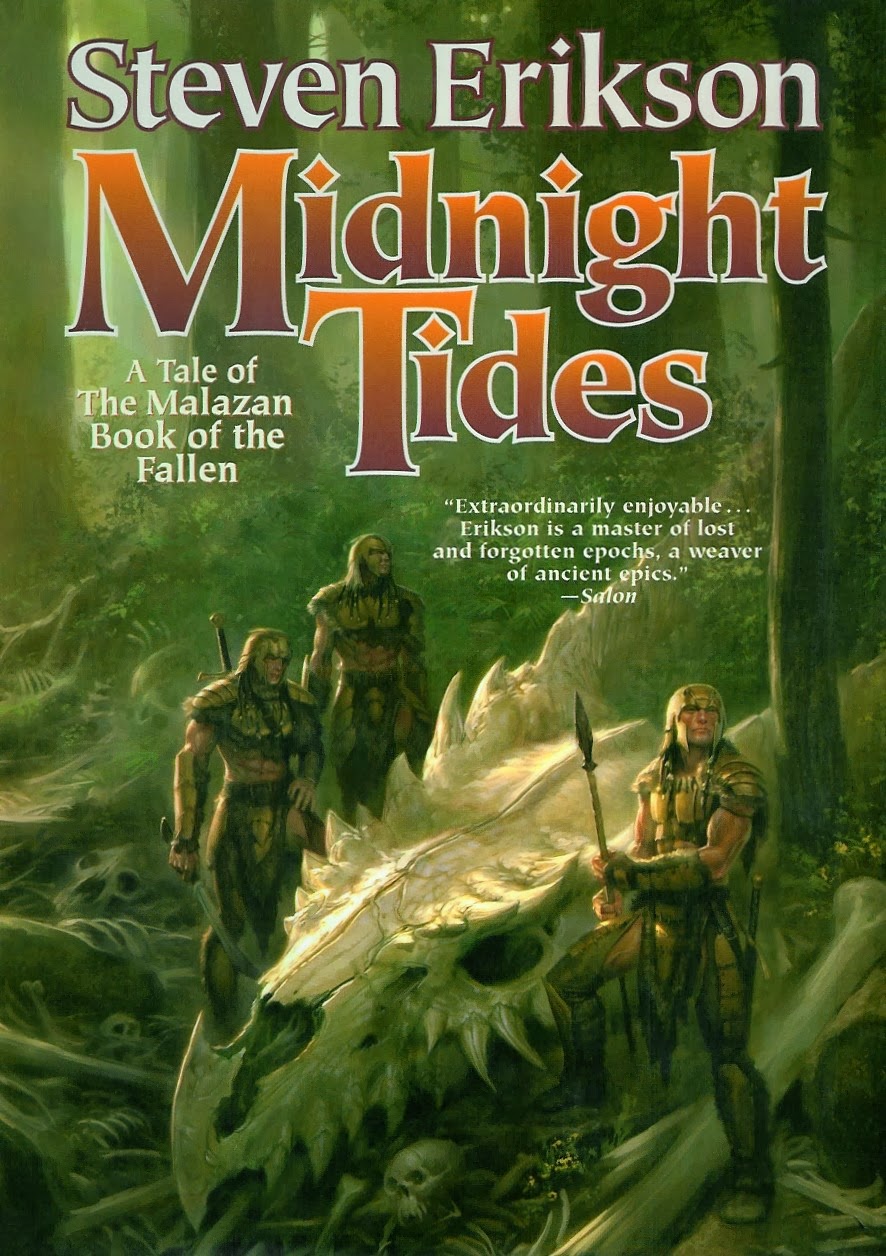
Book Review: Midnight Tides by Steven Erikson (The Malazan Book of the Fallen book 5)

Destiny is a lie. Destiny is justification for atrocity. It is the means by which murderers armour themselves against reprimand. It is a word intended to stand in place of ethics, denying all moral context.

                       -Steven Erikson, Midnight Tides

Today is a public holiday in Australia.
A gloomy day.
Rain filled the dark, grey sky as I close the last page of Midnight Tides, the fifth book in The Malazan Book of the Fallen series. Finally, I have reached the halfway point of this enormous series. I am truly impressed by this book, so without further delay, let me write a review for this book.


Synopsis:

The story in Midnight Tides takes place on the continent of Lether. The kingdom of Letherii, and an ancient people known as Tiste Endur co-habited on this continent. The Warlock King of Tiste Endur united the tribes after many years of warfare. The price of this unification is a pact with a twisted, hidden power with a motive of its own.

To the south, the Kingdom of Letherii is an expansionist society. Having annexed all of its neighbours, Letherii's next target is the land of Tiste Endur. As a scheduled meeting is about to take place between the Warlock King and the Letherii delegation to discuss a treaty, a storm is brewing, waiting to be released that will forever change the fate of these two people....

What I think about this book:

The Malazan Book of the Fallen is a huge series, so congratulations if you have made it to this book, the half way point in the series. Many fantasy series suffer from the “middle book syndrome”, where the middle book of the series doesn't live up to readers' expectations. This is not the case with Midnight Tides.

In this book, Steven Erikson introduces a completely new story arc, a cast of (almost) all new characters, and a new sub-continent. This new story arc, and these new elements, are all masterfully explored and introduced in a very good story. Comparing Midnight Tides with previous books, this book has less actions. However, what you will get here is vivid, imaginative world building and memorable character development.

There are many stars in this book. Two of my favorite characters in this book, are Tehol Beddict and his servant Bugg. Tehol possesses genius intellect, while his servant Bugg has a mysterious origin. In the story, this brainy, eccentric duo set off on a mission to topple the corrupted economic structure in the city of Lether, their story is both satirical and very relevant to our 21th century, materialistic society.

Through the eyes of Tehol and Bugg, and the many conversations between these two individuals, we are shown how greed and inequality impacts a civilization and its people. Their conversations are humorous and touching, at the same time, like a reflective mirror, their conversations reflect the fundamental problem with the way we define "value" in our own world. Another interesting character, is Rhulad Sengar, arguably the antagonist of this book. Yet, as the story unfolds, I wasn't so sure if Rhulad is the victimizer, or a victim to a greater scheme, plotted by a sinister, hidden power. In fact, I felt great sympathy towards Rhulad at the end of the story.

The star of this book, is Trull Sengar, the brother of Rhulad Sengar. This introspective Tiste Endur warrior acts as the pivotal character in this book. His relationship with his brother further flesh out the supporting characters in this book.

Every book in the Malazan series has a theme. For example, in book 4, House of Chains, the story explored the theme of vengeance and its consequences. In book 3, Memories of Ice, it explored the theme of compassion and its nature. In Midnight Tides, the story explores the problem of greed. The Letherii society value money as the most important thing of all. Their society is obsessed with the accumulation of wealth, and this obsession led to indebtedness and slavery. The Letherii economic system is capitalism on steroid, it is a system that punishes anyone who don't play well in the game of money making. It reminds me of the boom and bust economic system that dominates today's materialistic society, where we often think the righteous path of life is all about accumulating wealth and social status. Through this story, Steven Erikson shows the foolishness of this system and belief, how it can lead to corruption, loss of freedom and the ultimate collapse of a civilisation from the inside out.


I really like this book. It has fascinating characters, a vast, imaginative world, and a thought provoking story that seems most relevant to our world. In Midnight Tides, this fantasy novel has hit the truth about the problems in our contemporary world. If you haven't read The Malazan Book of the Fallen, then do yourself a favour, mark this on your reading list.


Saturday, January 18, 2014

Book Review: House of Chains by Steven Erikson (The Malazan Book of the Fallen book 4)

I was needed, but I myself did not need. I had followers, but not allies, and only now do I understand the difference. And it is vast.
                                    -  Steven Erikson, House of Chains

 Sometimes, vengeance seems to be the quickest, and the only way to justice. Yet, destruction resides at the heart of vengeance. If the nature of wrongdoing is destruction, then seeking vengeance is in fact, answering destruction with more destruction. This cycle breeds never-ending human tragedies. Until such a day, vengeance enslaves and chains us to its feet, and we find ourselves face to face with oblivion, where all gestures of mercy, compassion and forgiveness have departed from our souls long ago. Then Alas! It is too late to turn back. 

House of Chains, is the fourth book to The Malazan Book of the Fallen series. Written by Steven Erikson, this book explores the destructive nature of vengeance and its tragic consequence.

Synopsis:

House of Chains is a direct sequel to Deadhouse Gates. The story in House of Chains took place in the same time frame as Memories of Ice.

Following the events from Deadhouse Gates, the Whirldwind rebellion dominated the continent of Seven Cities. The Malazan empire seek to quench the rebellion, and regain control of the continent. For this purpose, Empress Laseeen elected Tavore Paran to be the new imperial Adjunct. However, Tavore is unaware that the leader of the Whirlwind rebellion, the seer Shai'k, is in fact her vengeful sister, Felisin Paran. 

In the meantime, a Teblor warrior, Karsa Orlong, departs from his mountain village on the continent of Genabackis, to forge a legend of his own.

What I think about this book:

This book has an unusual structure. The first 200 pages of this book introduced readers to a new character called Karsa Orlong. Lots of spotlights shined on him, showing the pivotal role this new character has to play in the series. Afterward, the other three quarters of the book focused on the Malazan army's campaign against the Whirlwind rebellion, a series of events building up to the final clash between Tavore Paran and her vengeful sister, Felisin Paran.

The method of storytelling in this book is unusual, and some readers will find it difficult to get into the story. Yet I have to say, Steven Erikson wrote the origin story of Karsa Orlong with such detail of emotions that it is perhaps, the best novella ever written in the genre of fantasy fictions.

In the beginning of the story, Karsa Orlong is a despicable character possessing immense martial prowess. After Karsa left his mountain village, he seek glories with deeds in war and violence. These deeds were not pretty, and readers will be appalled by Karsa's sense of value and morality. But the story doesn't end here. Formidable as he was, Karsa was captured while raiding a village and subsequently enslaved. Karsa lost his freedom, as he came into contact with a foreign world, his experience challenged him to reflect on his past, reviewing and doubting his former values. At the end of his ordeal, Karsa transformed from a despicable character, into the most interesting individual ever penned in fantasy fictions. The story of Karsa Orlong is powerful, because it represents a journey where life forced him to rethink everything he ever knew, shattering his entire worldview then rebuild it piece by piece.

There is a lot of character development here, Steven Erikson captured the full range of human complexities accompanying Karsa's journey of transformation, with the some of the most powerful writings in this genre. 

In fact, the story of Karsa Orlong engaged me so deeply that the rest of the book paled in comparison. This is not saying the other 600 pages of this book are bad. The rest of the book stood up on its own, it focused on the struggle between Tavore Paran and her sister, Felisin Paran. It shows that in seeking vengeance, one can be blind to the destruction it brings.

Just like other books in the Malazan series, House of Chains has a large cast of characters, both old and new. In this book, multiple, interwoven plots unfold at the same time. It is a challenge to keep track of different plots. The story is complex, demanding readers to pay close attention to every sentence. However, readers rip rewards from these investments, because characters cut deep impressions into their minds. All plots converged in the last 200 pages of this book, the story progressed at neck-breaking pace towards the monumental ending.

I love The Malazan Book of the Fallen. It is set in a fantastic world, telling stories of real, flawed people in large than life adventures. So far, each book in this series is built around a deep, meaningful theme, and House of Chains is no exception.

This is another great addition to the Malazan series. I can't wait to start reading the next book, titled Midnight Tides.


P.S Steven Erikson has written an insightful essay, titled: The problem of Karsa Orlong 


Saturday, January 11, 2014

Book Review: Memories of Ice by Steven Erikson (The Malazan Book of the Fallen Book 3)

We humans do not understand compassion. In each moment of our lives, we betray it. Aye, we know of its worth, yet in knowing we then attach to it a value, we guard the giving of it, believing it must be earned, T’lan Imass. Compassion is priceless in the truest sense of the wold. It must be given freely. In abundance.”
                
           - Steven Erikson, Memories of Ice


Memories of Ice, is the third book to The Malazan Book of the Fallen series. This series is probably the most ambitious, and most original fantasy epic ever written. This leviathan of a series runs 10 books in length, each volume measures between 700 to 1100 pages. The series' author, Steven Erikson, is trained in both archaeology and anthropology. With this knowledge, Erikson created a vivid, and intricate world complete with fascinating lores, larger than life myths, and beautiful histories. Combined with powerful characterisations, thought provoking philosophies, and unusual story structures, The Malazan Book of the Fallen is often regarded as one of the most significant fantasy series ever written.

In the past 2 weeks, I have read Gardens of the Moon and enjoyed it. Then I read Deadhouse Gates (the second instalment), only to be deeply moved by its powerful, yet tragic story. After reading 2 books, I was sold, I became a fan, and I couldn't wait to read Memories of Ice, the third book in this series.

Memories of Ice is a very long book, and it took me almost 40 hours to finish reading it. Today, I will like to review this book.

Synopsis:

The story in Memories of Ice takes place simultaneously with events in Deadhouse Gates. The story is set in the continent of Genabackis. Following the events in Gardens of the Moon, the empire of Pannion Domin is on the rise, its army inspired by religious fanaticism annexed and swallowed cities on Genabackis as a spreading, wild forest fire. A mysterious seer commands the Pannion army. But who is this seer? And what is his ambition? Many questions demand answers.

To stop this new threat, former High Fist Dujek and his Malazan army seek allies among their former nemesis, Caladan Brood, as well as the formidable Anomander Rake, Lord of Moon's Spawn. Now, former enemies united under a common cause, this alliance seeks to provide aid to the city of Capustan, besieged by the Pannion army.

Can this this alliance triumph against the Pannion threat?

In the meantime, a Rhavi woman appears on the scene with her daughter. A child whose origin is shrouded in mystery. Yet, this child may play a pivotal role in the upcoming struggle against the Pannions....

What I think about this book:

Memories of Ice is a long book, but I never experienced a dull moment while reading it. Simply said, Memories of Ice, is a great book.

Compared to the previous 2 books, this book is a lot easier to read. There are 3 reasons. Firstly, by now, I am used to Erikson's style of writing. Secondly, I have finally became familiar with with the world in Malazan series. And thirdly, the structure of this book is not as complex as the previous books. In this book, multiple plots develop with a unified purpose, to set up for the final confrontation against the Pannion seer and his fanatic army.
Memories of Ice has a very large cast of characters. Many of our favorite characters from Gardens of the Moon returned in this book, including Quick Ben, Whiskeyjack, Ganoes Paran and the Bridgeburners, Tool, Anomander Rake, Caladan Brood, and many others. Erikson also introduced new characters, all of them are memorable characters. As with previous books in this series, characterizations acted a robust backbone, on which a deeply emotional, and powerful story gradually unfold.

I don't want to show too many spoilers in this review, let me just say, Steven Erikson is not afraid of killing main characters. This makes the reading experience more gripping, because it creates a real sense of danger, when we read about our favorite characters stepping into perilous situations, where their ultimate demise may descend upon them at any given moment. George R.R. Martin is often praised for killing main characters, but I think Steven Erikson is at least on par with Martin in this regard.

But make no mistake, while Memories of Ice is a bit easier to read compared to previous books in this series. This book still demands readers to concentrate while reading. To understand this story is not as hard as rocket science. Yet, just like reading all other Erikson's books, you need to read carefully, and think, no skimming or you are bound to be lost and confused by the multiple, complex plots found in this book.

As I close the last page of this book, I was lost in thought with ones of the themes explored in this book, the nature of human compassion. In my opinion, while a story can be as dark as it is, yet a truly compelling story often touch those aspects lying deep in the hearts of our humanity. In this regard, Memories of Ice is a compelling story, proclaiming that in the midst of war, violence, and icy memories of tragic loss, under compassion, hopes can be found that bring promises of healing. A compassion, as Erikson said in this book, that is most priceless when it is freely given, in abundance.

Thank you for taking time to read my review. I eagerly look forward to reading the subsequent book in this series, House of Chains.


Monday, January 6, 2014

Book Review: Deadhouse Gates by Steven Erikson (The Malazan Book of the Fallen Book 2)


Children are dying."
Lull nodded. "That's a succinct summary of humankind, I'd say. Who needs tomes and volumes of history? Children are dying. The injustices of the world hide in those three words.”

                                  - Steven Erikson, Deadhouse Gates


Deadhouse Gates, is the second book to the epic fantasy series, The Malazan the Book of Fallen. Following the previous book, Gardens of the Moon, the story continues as new elements are introduced, including a cast of new characters, and a new continent complete with its own lores and history. Deadhouse Gates tells one heck of a story, both epic and tragic, capturing the story of humankind via a fictional history and its conflicts. Let's have a deeper look.


Synopsis:

Followed by the events in Gardens of the Moon, the story in Deadhouse Gates took place on the continent of Seven Cities. At the heart of this continent lies the holy desert of Rakaru, where an ancient prophecy known as the Whirlwind awakens, stirring the Seven Cities to rebel against its ruler, the Malazan Empire. At the head of this rebellion is a seer known as “Sha'ik”, who united the armies of Seven Cities into one terrible force. This combined force is a power not only breath-taking in its numbers, yet equally as savage in its intents. The Whirlwind rebellion wages a war against the Malazan Empire that will prove to be the bloodiest conflict yet to be witnessed by the imperial history.

Coltaine, the legendary warleader of the Crow Clan of the Wickans, is appointed Fist for the Malazan 7th imperial army. He leads an army made up of his Wickan followers and the Malaz 7th army. A talented and charismatic leader, Coltaine commands a powerful and inspiring presence in his army. As the rebellion develops, cities were overrun by the rebel forces, while Coltaine and his army are the only opposing force standing against the might of the Seven Cities.

As the continent gradually fell into the hands of the rebel forces, Coltaine and his loyal soldiers are tasked with a paramount mission to escort 50,000 refugees to safety by crossing a continent, a journey some 1500 miles long. This mission is both dangerous and difficult, because on this march, not only do Coltaine's group have to survive in the desert wasteland, but they also have to escape from the colossal army of Seven Cities in pursuit, led by a man who seeks to destroy Coltaine's group completely. This legendary march becomes known as “Chain of Dogs”, a tale forever embedded into the history of Seven Cities. Can Coltaine succeed?

In the meantime, the assassin Kalam attempts a dangerous mission to assassinate Empress Laseen, while other travellers from the continent of Genabackis arrive at Seven Cities with different quests of their own...

What I think about this book:

I am truly impressed with this book. Gardens of the Moon was good, but Deadhouse Gates is a quantum leap from its predecessor. Steven Erikson drives a story both epic in scale, and tragic in its telling. Some characters from Gardens of the Moon returned in this book, but Erikson also introduced readers to a new cast of impressionable characters, setting the story in a new continent complete with its own lores and history. The imaginative works presented in this book are simply, amazing.

Just like Gardens of the Moon, the story in Deadhouse Gates is complex and intricate. 4 story arcs develop simultaneously throughout this book. Initially, these story arcs don't seem to connect. However, towards the end, these plots gradually converge and everything falls into place. This does mean, that readers have to invest time to read this book, no skimming is allowed while reading it. Because admittedly, it is a bit of a work to keep track of different plots and new characters. The good news is, for all these works, readers will be rewarded with immense satisfaction as the story unfolds towards its monumental ending.

I love the characterisation in Deadhouse Gates. Not only did Erikson expand the stories of some returning characters from the first book, but he also introduced readers to memorable characters who made their first appearances in the story. In this instance, the shining star of this book, is Coltaine, the legendary war leader of the Crow Clan. Throughout this book, Coltaine's powerful presence, stoicism, and his iron bound determination to escort refugees to safety, cut bone-deep impression in my mind. Not to mention I was deeply moved by the ending, all choked up as I close the last page of this beautiful book.

In Deadhouse Gates, characterisation has improved greatly compared to the previous book. Readers get to meet the characters, explore their thoughts, strengths and weaknesses as Erikson beautifully captured the essence of human complexities in suffering and in war, while this story, both tragic and hopeful, draws to a close and setting up the themes for the anticipated sequel.

Deadhouse Gates is a great book, it raised the bar of standard for the Malazan series, and I cannot wait to read the next instalment, a book sitting on my bookshelf right now, titled Memories of Ice.